








There is a point at which political generosity becomes self-deception, and Antigua and Barbuda is dangerously close to that point in how it continues to treat the United Progressive Party—as though it is a government-in-waiting rather than what it has repeatedly demonstrated itself to be: a fractured organisation, rejected at the polls, and unable to reconcile its own leadership contradictions.

Because when stripped of slogans and sentiment, the UPP’s recent history is not one of momentum, but of defeat followed by disorder.
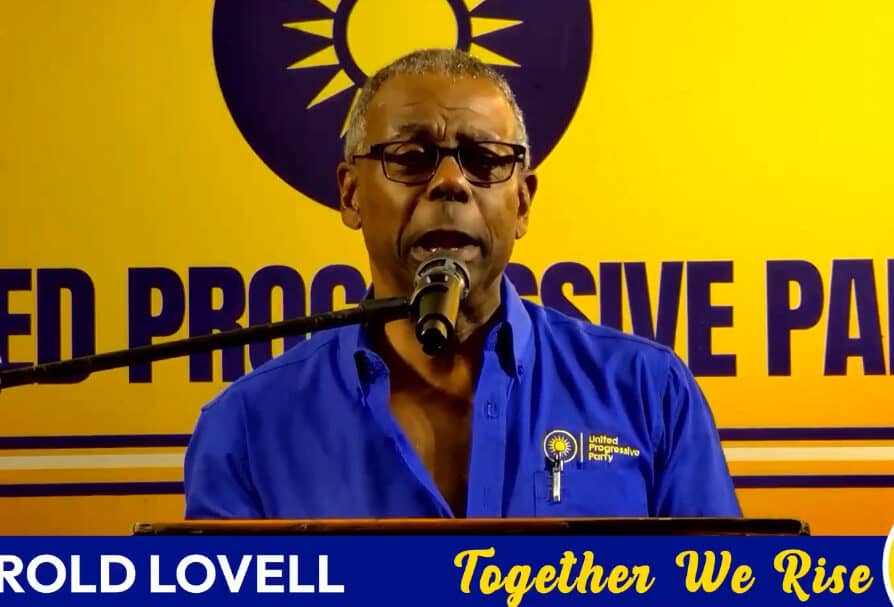
Harold Lovell, the party’s long-standing political leader and central economic voice, did not merely lose nationally—he was decisively rejected within his own constituency of St. John’s City East, three consecutive times. In any serious political system, that level of rejection would trigger not just resignation, but renewal. Instead, what followed within the UPP was not clarity, but confusion—a leadership vacuum awkwardly filled, not resolved.
Enter Jamale Pringle, elevated to leadership but never fully consolidated as such, existing in a political space where authority appears shared, contested, or quietly undermined. The result is a party that cannot clearly answer a basic question: who is actually in charge?
Is it Pringle, the parliamentary leader, tasked with carrying the opposition forward?
Is it Lovell, still looming as the party’s intellectual and political centre of gravity despite electoral rejection?
Or is it Giselle Isaac-Arrindell, whose chairmanship has increasingly appeared less like stewardship and more like containment—managing fallout, issuing denials, and attempting to project unity where there is little evidence of it?
This is not a leadership structure. It is a fault line.

And the cracks are not theoretical—they have been visible, repeated, and unresolved. The UPP has already lived through internal rupture at the highest level, most notably with Joanne Massiah, whose challenge to leadership exposed a culture that struggles to accommodate dissent without implosion. That episode did not strengthen the party. It revealed its fragility.
Nothing since suggests that fragility has been addressed.
Instead, the party now operates in a state of quiet contradiction: presenting Pringle as leader while never fully displacing Lovell’s influence, defending unity while repeatedly forced to respond to reports of internal tension, and attempting to project readiness while still negotiating its own internal hierarchy.
And this dysfunction is reflected in its electoral footprint.
In constituency after constituency, the UPP has failed to build the kind of durable, disciplined ground operation that wins elections. This underscores a deeper issue: the party’s inability to convert visibility into victory. Noise into numbers. Presence into power.
Even in moments where political opportunity exists—whether through shifting public sentiment or isolated dissatisfaction—the UPP has struggled to capitalise in a structured, strategic way. There is no clear evidence of a national electoral machine operating with precision, no indication of a coordinated constituency-level strategy capable of delivering consistent wins across cycles.
And that failure cannot be blamed indefinitely on external factors. At some point, it must be recognised for what it is: a reflection of internal disorganisation and strategic inconsistency.
Compounding this is the party’s continued reliance on a style of politics that prioritises reaction over construction. Complex national issues—economic diversification, digital transformation, youth employment, social protection—are engaged at the level of commentary rather than policy architecture. There is critique, yes. But where is the detailed alternative? Where is the costed plan? Where is the coherent framework that signals readiness not just to oppose, but to govern?
It is not enough to say what is wrong. A serious political organisation must demonstrate what it would do differently—and how.
The UPP has not done so in any sustained or convincing way.
What remains, then, is a party caught in a loop: rejected leadership recycled into influence, new leadership constrained by old power structures, internal disputes managed rather than resolved, and electoral underperformance reframed as temporary rather than systemic.
This is not a government-in-waiting.
It is a party still trying to decide what it is.
And until that question is answered—clearly, decisively, and publicly—it cannot credibly ask the people of Antigua and Barbuda to entrust it with the far greater responsibility of governing a nation.
Because if a party cannot unify itself, it cannot lead a country.
Advertise with the mоѕt vіѕіtеd nеwѕ ѕіtе іn Antigua!
We offer fully customizable and flexible digital marketing packages.
Contact us at [email protected]



POOR HAROLD. Barbara Coates said that you BADPLAY She. Barbara Coates want to represent All Saints West because She realize Harold will lose.
The ONE AND ONLY DULY ELECTED LEADER OF THE UPP is the HON. LARS JAMALE PRINGLE
“This is not a government-in-waiting. It is a party still trying to decide what it is.”
You know it’s General Election time, when the UPP hit piece articles; opinions and made up stories come flooding in like rapid fire attacks.
The ABLP propaganda has well and truly commenced in earnest.
Sadly many cannot see it…
Ah who write this article?
Eh, who?
Analyze and critique the upp..
No problem..
Analyze and the critique the current labor party government, please..
Please include they’re accomplishments and short commins..
Ps.. don’t forget to include the current leader dependency on Risperdal to remain
Calm and collected and to control mood swings and depression 🫥
I will take a intellectual, smart, leader
Than a mental deficient one..
Antigua you get a government you deserve..
A mental patient controlling the masses. 🤣🤣🤣🤣🤣🤣
Chaotic set a people. Not even Gorilla Glue can stick them together.
This is rather sad, but shockingly true. The people are looking for an opposition party but all we get is internal opposition with a outward projection of unity.
Gaston stop blogging under different names against Lovell, your envy of Lovell is too much now, get a life.
Funny how the same people telling us Jamale Pringle is a weak leader are the very ones turning around and asking us to vote for him.
Harold, Shugy Serpent, Sheffield, and Richard can’t have it both ways if you don’t trust Hon Jamale Pringle to lead, why should we the people?
Thank Goodness the public is Not confused about who deserves their confidence and vote. #VoteABLP