






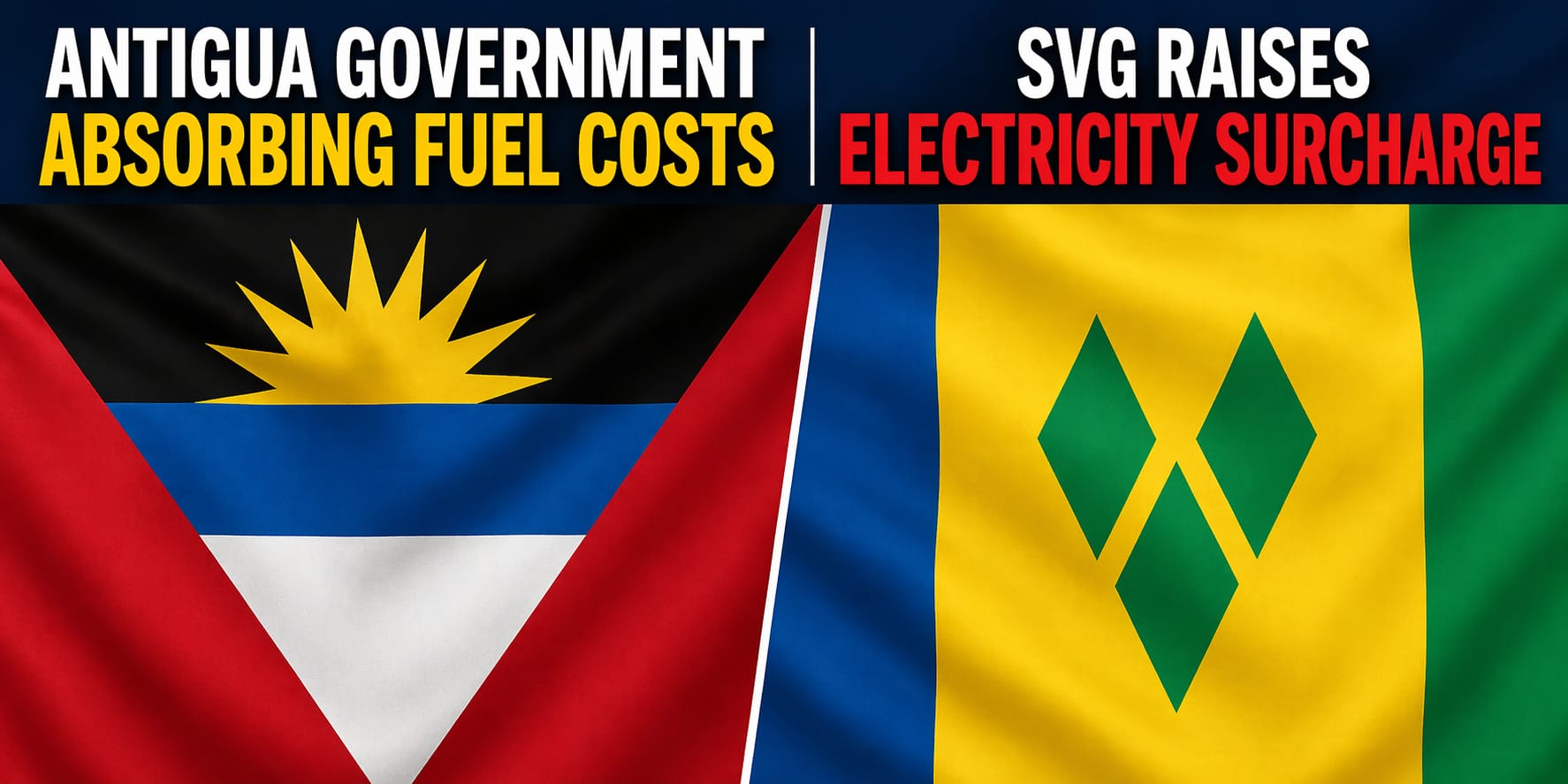



Antigua Government Absorbing Fuel Costs While SVG Raises Electricity Surcharge

The government of Antigua and Barbuda is continuing to absorb rising global fuel costs in an effort to shield consumers from higher electricity and transportation prices, even as neighbouring St. Vincent and the Grenadines moves to pass those increases directly onto consumers.
Prime Minister Gaston Browne has said the policy is part of a broader cost-of-living strategy aimed at maintaining price stability across the economy.
Recent reports indicate that the government is subsidising fuel at a rate of about $1.67 per gallon, including fuel used to generate electricity, in order to prevent higher utility bills for households. (Antigua News Room)

Browne has also explained that Antigua has reduced the level of consumption tax collected on fuel to keep pump prices stable, despite increases in global oil prices. (Jamaica Observer)
The approach has helped maintain relatively steady fuel prices locally, even as international costs rise due to geopolitical tensions and supply pressures.

Officials warn, however, that the policy places pressure on public finances and may not be sustainable indefinitely if global prices continue to climb. (Antigua News Room)
Contrast with St. Vincent and the Grenadines

The situation contrasts sharply with developments in St. Vincent and the Grenadines, where the state-owned St. Vincent Electricity Services Limited (VINLEC) has announced an increase in its fuel surcharge.
The surcharge will rise to $0.6650 per kWh for April 2026, up from $0.5490 the previous month — an increase of $0.116 per kWh.
VINLEC said the adjustment reflects higher international fuel costs and reduced generation from renewable energy sources. The company noted that the surcharge is a pass-through charge used solely to recover fuel costs and does not generate profit.
The utility also pointed to ongoing conflict in the Middle East as a factor contributing to global fuel price increases, urging customers to conserve energy where possible to mitigate higher bills.
Across the Caribbean, governments and utilities are grappling with the same external pressures — rising oil prices, supply disruptions, and geopolitical instability — but responses vary.
Antigua and Barbuda has opted to cushion consumers through subsidies and tax reductions, while St. Vincent and the Grenadines has passed the increase directly to electricity consumers through higher surcharges.
Economists note that while subsidies can provide short-term relief, they often come with long-term fiscal risks, especially for small island economies heavily dependent on imported fuel.
Browne has acknowledged that reality, warning that continued global volatility could eventually force adjustments despite current efforts to hold prices steady.
Advertise with the mоѕt vіѕіtеd nеwѕ ѕіtе іn Antigua!
We offer fully customizable and flexible digital marketing packages.
Contact us at [email protected]