










CNW/The U.S. Department of State has updated its visa reciprocity schedules for citizens of Dominica and Antigua and Barbuda, drastically shortening the validity and entry privileges of key work and dependent visas previously issued with long-term terms.

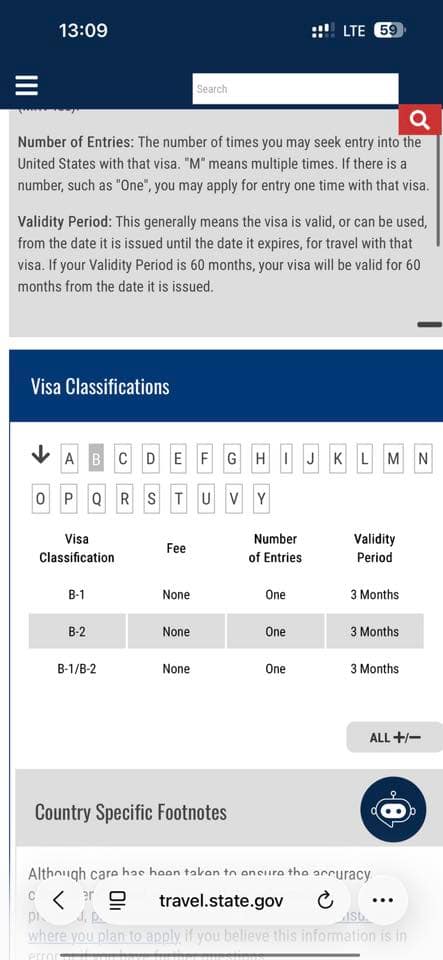
Under the updated schedule, several work, dependent, and visitor visa categories for both countries — including H‑1B, H‑1C, H‑2R, H‑3, H‑4 (work and dependent visas), as well as B‑1, B‑2, and B‑1/B‑2 (business and tourist visas) — will now generally be issued with just a three‑month validity period and a single entry into the United States.
Previously, some of these visas could be issued with multi‑year validity, sometimes up to 10 years, allowing holders to enter the U.S. multiple times without reapplying. The new change significantly shortens both the length of the visa and the flexibility for multiple entries

- Reciprocity Fee: None — applicants do not pay an extra issuance fee beyond the standard visa application charge.
- Number of Entries: One — the visa holder may use the visa to enter the U.S. only once.
- Validity Period: Three months from issuance — the visa must be used within that timeframe, though length of stay once admitted is set by U.S. Customs and Border Protection (CBP) and not by the visa itself.
These updates come amid broader U.S. scrutiny of citizenship‑by‑investment (CBI) programs in the Eastern Caribbean, including those operated by Dominica and Antigua and Barbuda, which grant citizenship in exchange for investment. Caribbean CBI programs have drawn international attention over the past several years, with critics arguing that some variants lacked residency requirements and comprehensive vetting, potentially creating security and identity verification concerns.

Earlier in 2026, the U.S. expanded travel and entry restrictions toward several countries, citing national security and public charge concerns. As part of that effort, additional requirements and limitations — such as higher financial bonds for Antigua and Barbuda and Dominica passport holders applying for certain visas — have also been introduced.
Antigua and Barbuda’s government acknowledged the evolving visa environment and announced efforts to “align” its biometric systems with U.S. requirements within a 90‑day window to improve predictability for applicants.

These changes represent a major reversal from the longer‑term, multiple‑entry U.S. visa access that Dominicans and Antiguans were previously accustomed to.
Travelers who already hold valid visas issued under the older terms can continue to use them for entry, but new applicants may see more limited validity and must plan accordingly.

Applicants from Dominica and Antigua and Barbuda should check the U.S. State Department’s official website for the full list of affected visa categories and detailed requirements.
Advertise with the mоѕt vіѕіtеd nеwѕ ѕіtе іn Antigua!
We offer fully customizable and flexible digital marketing packages.
Contact us at [email protected]




Stay away from Drugs. And right now the USA is like drugs.
If you can get a three months visa to enter the US, isn’t that enough? As I see it, most overseas vacations is about one to two weeks, depending on your savings, you need to shop in the US, that’s should be around the same time frame, and as for a business engagement, a week.
There is know reason why a granted three months visa, by any government to enter his country, deemed not enough. I guess over the years we’ve been spoiled, and never thought this day would come. As a matter of fact, some of our own countrymen and women help move this along. Citizen by investment is just platform and has nothing to do with this. The US administration knows who they want in their country, and presently ICE is on a move, trying to clean up the US, and most of the people they are after are the people like us who still don’t get the picture.
Gaston! Gaston! Get out of Antiguans and Barbudans future and right to human dignity realizing all their aspirations, you are a blockage to antiguan and barbudans prosperity while you full you pockets through CIP and lands venture to foreigners, and overwhelming amnesty passport issuance to Caribbean nationals to anchor yourself in the seat of government, you can clearly see that the USA and Canada is saying you are not a legitimate government elected democratically by the citizens of the two respective countries mention for sanctions or reduced access to the American mainlands, we sending syrians, Iranian and Jamaican and Guyanese with passport stating they born in Antigua or for Roosevelt skerrit in Dominica doing the same for the terrible master that rules both Gaston brown and Roosevelt skerrit which is MONEY!
For your Information the passports DO NOT say you are born in Antigua, it gives your Country of birth, so everyone is well aware that you were born elsewhere but live in Antigua and Barbuda.
@Carvaa, many Antiguans would travel to the USA multiple times in a year because of the close proximity and the tradition ties we share. It is therefore a bit deal especially when it might mean an in person interview and therefore the need to travel to Barbados to do so. If it were just an online application or Visa and the processing fees were reasonable, then it would not have been a big deal.
Canada is looking like a much better option.
Don’t depend on Canada and the EU long term. They have been warning us for years. Expect a clamp down as well from them in the next few years.
Comments are closed.