









By Dr. Isaac Newton

I was deeply touched by his incredible capacity to let words and meaning jolt the soul through the rhythm of hope, the call to faith, and his relentless pursuit of freedom, dignity, and justice for all, especially the downtrodden and outcast. Long before I met him, his voice had already crossed oceans and entered the crowded chambers of my own conscience. Then I met him in Jersey City when he attended an African American Interdenominational Convention. His presence was radiant, marked by his moving smile and infectious, confident humility that drew people to him with a sense of wonderment and whispering pride. In that room I encountered a leader and a living sermon. Before my eyes stood a man whose very cadence carried the heartbeat of generations who had been told to wait their turn in history.
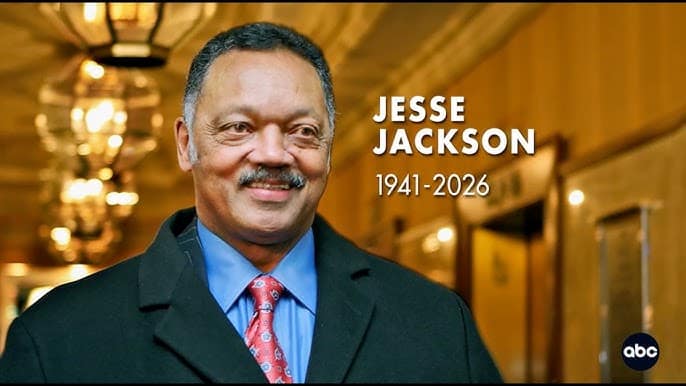
The man was Jesse Jackson, but the moment belonged to something larger than biography. He rose from the soil of segregation and shaped his public life with the discipline of Christian conviction and the daring imagination of prophetic faith. As a protégé of Martin Luther King Jr., he learned that moral courage must be organized and that faith without public action is only private comfort. His declaration to keep hope alive evolved beyond a slogan into a theology of survival for people battered by exclusion. When he affirmed that he was somebody, he was restoring sacred worth to those who had been measured and dismissed. He taught that dignity is conferred by the Creator, not the powerful, and therefore cannot be revoked by prejudice, poverty, or political neglect.

For Caribbean and African peoples, his words traveled like trade winds across the Atlantic. In Kingston, Port of Spain, Bridgetown, Georgetown, Lagos, Monrovia, Accra, Nairobi, and Gaborone, communities wrestling with the aftershocks of colonialism and economic vulnerability heard in his voice a summons to believe again. Hope, in his lexicon, was nothing short of disciplined resistance. It was the courage to count the cost of freedom and to pay it with patience, organization, and sacrifice. He insisted that faith must move beyond sanctuary walls into voting booths, classrooms, boardrooms, and streets. He spoke to fishermen and factory workers, to teachers and taxi drivers, to students who feared their dreams were too fragile for harsh realities. His mission dignified ordinary labor and reminded entire regions that the foundation of justice is built by hands that history often overlooks.

Yet his majesty did not depend on perfection. He faced his own foibles in public view, and critics were swift and relentless. What distinguished him was not an absence of flaw but an unwillingness to be imprisoned by it. He understood that moral authority will not share the same room with moral infallibility. His Christian faith compelled confession, correction, and continuation. In this he modeled a rare form of leadership for a skeptical age. He showed that one can stumble and still stand for something larger than the stumble. For communities accustomed to seeing their champions either idolized or discarded, his resilience offered a third path, accountability without annihilation. That lesson is vital for societies struggling to nurture leaders who are human yet heroic in purpose.
As he transitions from the center of public life into the solemn dignity of legacy, his meaning deepens. The majesty of Reverend Jackson lives in the marches he led, the speeches he delivered, and in the moral vocabulary he expanded for the world. He taught that hope is a discipline, that dignity is sacred, that freedom demands cost, and that faith can animate public courage across race, region, and religion. His love for ordinary men and women of all races transcended pedigree and geography because he believed each person bore a divine imprint. For Caribbean and African peoples, and for all who yearn to triumph over despair, his life stands as a testament that history can bend when souls refuse to bow. His legacy lives on, both as memory and as mandate for generations yet unborn to keep hope alive and to rise each morning declaring with conviction that they too are somebody.

EDITOR’S NOTE: Dr. Isaac Newton is a globally experienced thought leader, Harvard, Princeton, and Columbia trained strategist, and advocate for social justice and leadership excellence. With over 30 years of expertise in bridging cultural, economic, and ideological divides, he brings a nuanced perspective to complex issues shaping global and regional landscapes.
Advertise with the mоѕt vіѕіtеd nеwѕ ѕіtе іn Antigua!
We offer fully customizable and flexible digital marketing packages.
Contact us at [email protected]