






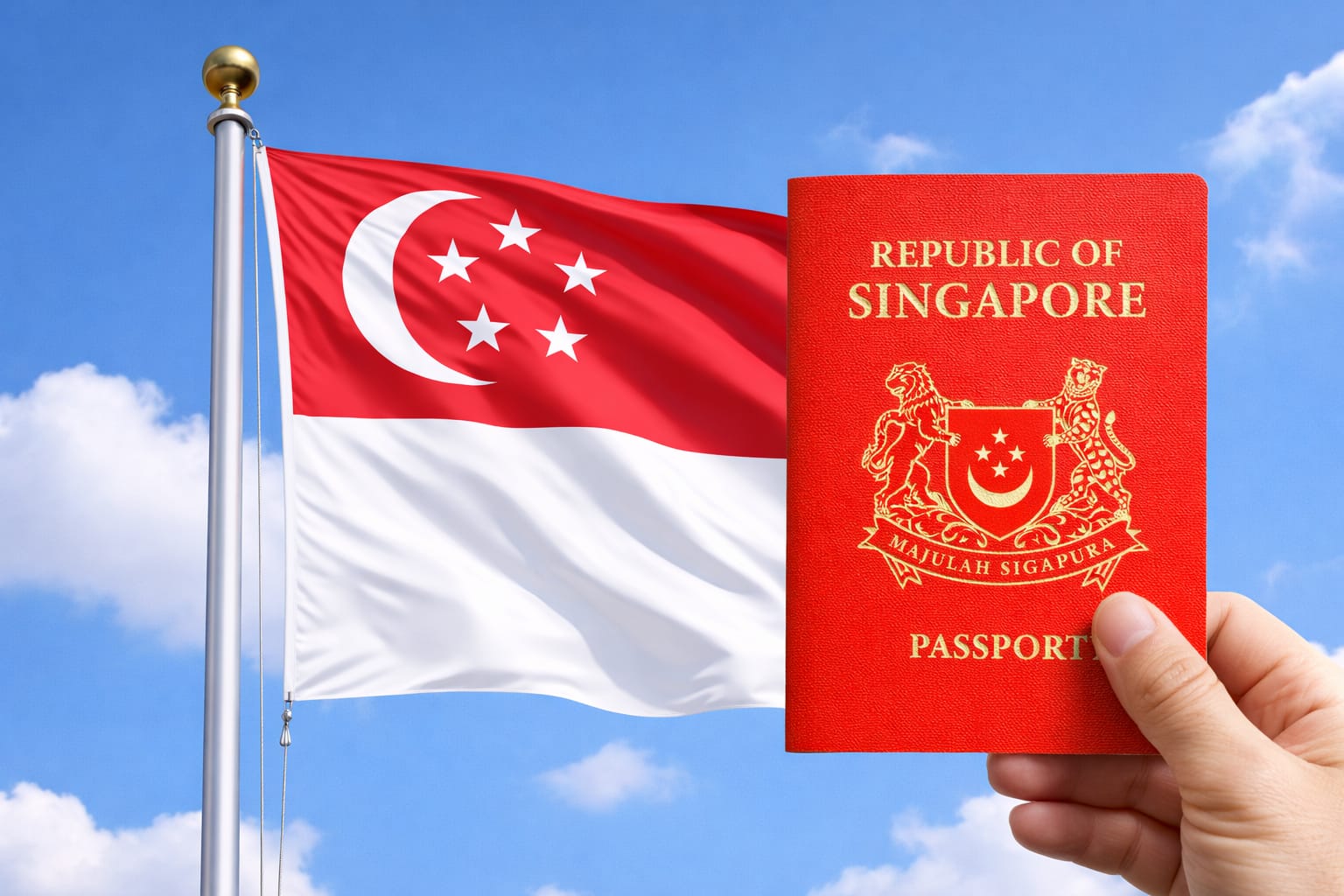



Marking two decades since its inception, the Henley Passport Index 2026 reveals a growing divide between the world’s most and least mobile populations. Created 20 years ago and based on exclusive Timatic data from the International Air Transport Association (IATA), the index ranks all the world’s passports according to the number of destinations their holders can access without a prior visa. While a record number of passports now cluster at the top of the ranking, those at the bottom remain increasingly isolated, underscoring a widening global mobility gap.

At the pinnacle of the index, Singapore retains its position as the world’s most powerful passport, offering access to 192 destinations visa-free. At the opposite end of the spectrum, Afghanistan once again ranks last, with its passport holders able to travel to just 24 destinations without a prior visa. The resulting 168-destination gap starkly illustrates the scale of global mobility inequality in 2026 — a dramatic widening of the divide since 2006, when the difference between the then top-ranking US passport and Afghanistan was only 118 destinations.
“Over the past 20 years, global mobility has expanded significantly, but the benefits have been distributed unevenly”, says Dr. Christian H. Kaelin, Chairman at Henley & Partners and creator of the Henley Passport Index. “Today, passport privilege plays a decisive role in shaping opportunity, security, and economic participation, with rising average access masking a reality in which mobility advantages are increasingly concentrated among the world’s most economically powerful and politically stable nations.”

This imbalance is intensifying even as international travel demand continues to grow. IATA forecasts that airlines will carry more than 5.2 billion passengers globally this year.

“A record number of people are expected to travel in 2026. The unequivocal economic and social benefits generated by this travel grow as it becomes more accessible. But while more people have the economic freedom to travel, many nationalities are seeing that a passport alone is no longer sufficient to cross borders”, says IATA Director General Willie Walsh. “As many governments look to more tightly secure their borders, technological advances such as digital ID and digital passports should not be overlooked by policymakers. Convenient travel and secure borders are possible.”
UK Records the Steepest Year-on-Year Losses, US Back in the Top 10

Japan and South Korea rank joint 2nd in 2026, each offering visa-free access to 188 destinations, reinforcing Asia’s long-standing leadership at the top of the global mobility rankings. Denmark, Luxembourg, Spain, Sweden, and Switzerland follow in 3rd place with access to 186 destinations, ahead of an unprecedented group of 10 European countries tied for 4th.
The remainder of the upper-tier passports continue to underscore Europe’s dominance, with notable exceptions including UAE (5th), New Zealand (6th), Australia (7th), Canada (8th), and Malaysia (9th).

The US has returned to the Top 10 after briefly dropping out for the first time in late 2025, but this recovery masks a longer-term decline for both the US and the UK, which jointly held 1st place in 2014. The past year saw both countries record their steepest annual losses in visa-free access, shedding seven and eight destinations, respectively. The US has suffered the third largest ranking decline over the past two decades — after Venezuela and Vanuatu — falling six places from 4th to 10th, while the UK ranks as the fourth-biggest faller, down four places from 3rd in 2006 to 7th in 2026.
“Passport power ultimately reflects political stability, diplomatic credibility, and the ability to shape international rules”, says Misha Glenny, award-winning journalist and Rector of the Institute for Human Sciences in Vienna. “As transatlantic relations strain and domestic politics grow more volatile, the erosion of mobility rights for countries like the US and UK is less a technical anomaly than a signal of deeper geopolitical recalibration.”
Biggest Risers and Fallers Over the Decades
The UAE stands out as the strongest performer on the Henley Passport Index over the past 20 years, adding 149 visa-free destinations since 2006 and climbing 57 places to 5th on the rankings with access to 184 destinations visa-free, driven by sustained diplomatic engagement and visa liberalization.
Countries across the Western Balkans and Eastern Europe have also made significant gains over the past two decades, led by Albania, which climbed 36 places to rank 43rd on the index. Ukraine has risen 34 places (to 30th), followed by Serbia (+30 to 34th), North Macedonia (+27 to 38th), and both Bosnia and Herzegovina (+29) and Georgia (+26), which now share 42nd place. Together, these advances highlight the impact of regional integration and closer alignment with key partners.
Bolivia is the only country on the index to have seen an overall decline in visa-free access over the past 20 years, losing 5 visa-free destinations and falling 32 places to rank at 61st in 2026.
If we just consider the last decade, Kosovo has seen the biggest rise in the ranking, up 38 places (from 97th to 59th since 2016) with access to an additional 43 destinations. Another notable climber is China, which has risen 28 places (from 87th to 59th) over the past 10 years, adding an additional 31 destinations to its total score of 141 countries that its citizens can now visit without a prior visa.
Open Borders, Closed Doors
While US passport holders can travel visa-free to 179 destinations, the United States itself allows only 46 nationalities to enter without a prior visa, placing it 78th out of 199 countries and territories worldwide on the Henley Openness Index. This disparity between outbound mobility and inbound openness is among the widest globally, second only to Australia and marginally ahead of Canada, New Zealand, and Japan.
By contrast, China has risen rapidly, granting visa-free access to over 40 additional countries over the past two years alone. Now ranked 62nd, China permits entry to 77 different nationalities — 31 more than the US — signaling a strategic pivot towards openness as a tool of diplomacy and economic engagement.
“There is a visible shift underway in the global balance of power, marked by China’s renewed openness and the USA’s retreat into nationalism”, says Dr. Tim Klatte, Partner at Grant Thornton China. “As countries increasingly compete for influence through mobility, openness is becoming a critical component of soft power.”
From Visa-Free to Full Disclosure at America’s Borders
Exclusive analysis commissioned for the Henley Global Mobility Report 2026, released today alongside the latest Henley Passport Index, warns that a late-2025 proposal by U.S. Customs and Border Protection could effectively end visa-free travel to the US in all but name. The plan would require citizens of 42 allied nations — including the UK, France, Germany, and Japan — to submit extensive personal data under the Visa Waiver Program, with implementation possible as early as February following a public consultation.
If adopted, travelers would be required to disclose five years of social media activity, ten years of e-mail addresses, phone numbers, and IP addresses, as well as detailed family information and biometric data — including facial recognition, fingerprints, and DNA — retained for up to 75 years, far exceeding current Electronic System for Travel Authorization (ESTA) requirements.
“For Europeans long accustomed to near-frictionless travel, the implications go far beyond inconvenience”, warns Greg Lindsay, non-resident senior fellow at the Atlantic Council and senior fellow at Arizona State University’s Threatcasting Lab. “This level of data collection enables real-time ideological screening and creates the risk that personal information could be shared, repurposed, or weaponized.”
These proposals follow a series of recent US measures, including visa bans on former European Commission Vice-President Thierry Breton and several European activists, and the most extensive simultaneous expansion of US travel bans in modern history. From 1 January 2026, full or partial entry restrictions now apply to 39 countries.
EU Visa Reforms Reinforce Bias Against Africans
As Washington’s ‘America First’ agenda hardens borders — with 16 of the 20 countries facing new US travel restrictions or outright bans located in Africa — similar dynamics are now emerging in Europe.
Exclusive research commissioned for the Henley Global Mobility Report 2026finds that recent EU visa reforms are deepening the global mobility divide for African travelers, despite rising demand linked to work, education, and family ties. Authored by Prof. Mehari Taddele Maru of the European University Institute and Johns Hopkins University SAIS, the study shows that access to Schengen visas is becoming increasingly restrictive even as mobility pressures intensify.
Eurostat data reveals that between 2015 and 2024, Schengen visa rejection rates for African applicants climbed from 18.6% to 26.6%, while application volumes rose only marginally. Reforms introduced between 2024 and 2025 — including higher fees, longer processing times, expanded surveillance, and punitive sanctions — are expected to drive rejection rates higher still, further entrenching unequal access to mobility.
“These policies do not simply regulate mobility — they institutionalize it”, says Prof. Maru. “What we are witnessing is a form of conditional racial discrimination in visa policymaking, shaped by geopolitical power rather than individual risk.”
The research concludes that EU visa sanctions and the rollout of its Entry/Exit System compound this exclusion by raising financial and administrative barriers, extending processing times, and intensifying surveillance for travelers from countries already facing the highest rejection rates.
Mobility Planning Accelerates as Risk Management Becomes a Priority
Demand for additional residence and citizenship rights continue to diversify and deepen. In 2025 alone, Henley & Partners received applications from 100 different nationalities, rising to 142 nationalities over the past five years, across more than 60 options worldwide. By the end of last year, overall application volumes were 28% higher than in 2024.
Led by the US, the remaining top five countries from where applications originate are Türkiye, India, China, and the UK, with applications from Brits rising to unprecedented levels in 2025.
“What we are seeing is a fundamental shift in how globally mobile individuals think about access and security”, says Dr. Juerg Steffen, CEO at Henley & Partners. “In an era of geopolitical uncertainty and increasingly fragmented travel regimes, residence and citizenship planning has evolved into an essential strategy for building resilience, optionality, and mobility certainty across multiple jurisdictions.”
This shift is most pronounced among US nationals, now the firm’s largest client market. “Americans are continuing their scramble for alternative residence and citizenship amid ongoing political turbulence, with interest now at an all-time high”, confirms Prof. Peter J. Spiro, Professor at Temple University Law School. “What was once seen as an extreme contingency has become a mainstream form of risk management — a durable Plan B that offers security, mobility, and peace of mind in an increasingly unpredictable world.”
Ends.
Notes to Editors
About the 2026 Henley Passport Index
With cutting-edge expert commentary and historical data spanning over 20 years, the Henley Passport Index is the original ranking of all the world’s passports according to the number of destinations their holders can access without a prior visa.
Originally created by Dr. Christian H. Kaelin, the ranking is based on exclusive and official data from the International Air Transport Association (IATA), which maintains the world’s largest and most accurate database of travel information, and it is enhanced by extensive, ongoing research by the Henley & Partners Research Department.
Along with the Kälin – Kochenov Quality of Nationality Index, it is considered a major tool for global citizens and the standard reference for government policy in this field.
About the Henley Global Mobility Report
The Henley Global Mobility Report is a unique annual publication that brings together commentary from leading academics and professional experts on the major and emerging trends in global and regional mobility today.
Grounded in geopolitical analysis and with a focus on the realities shaping our world, the report offers exclusive insight into mobility and migration patterns and looks at what we can expect in the months to come.
About Henley & Partners
Henley & Partners is the global leader in residence and citizenship planning. Each year, hundreds of wealthy individuals and their advisors rely on our expertise and experience in this area. The firm’s highly qualified professionals work together as one team in over 70 offices worldwide.
The concept of residence and citizenship planning was created by Henley & Partners in the 1990s. As globalization has expanded, residence and citizenship have become topics of significant interest among the increasing number of internationally mobile entrepreneurs and investors whom we proudly serve every day.
Henley & Partners also runs the world’s leading government advisory practice for wealth migration, which has raised more than USD 15 billion in foreign direct investment. Trusted by governments, the firm has been involved in strategic consulting and in the design, set-up, and operation of the world’s most successful residence and citizenship programs.
Advertise with the mоѕt vіѕіtеd nеwѕ ѕіtе іn Antigua!
We offer fully customizable and flexible digital marketing packages.
Contact us at [email protected]