






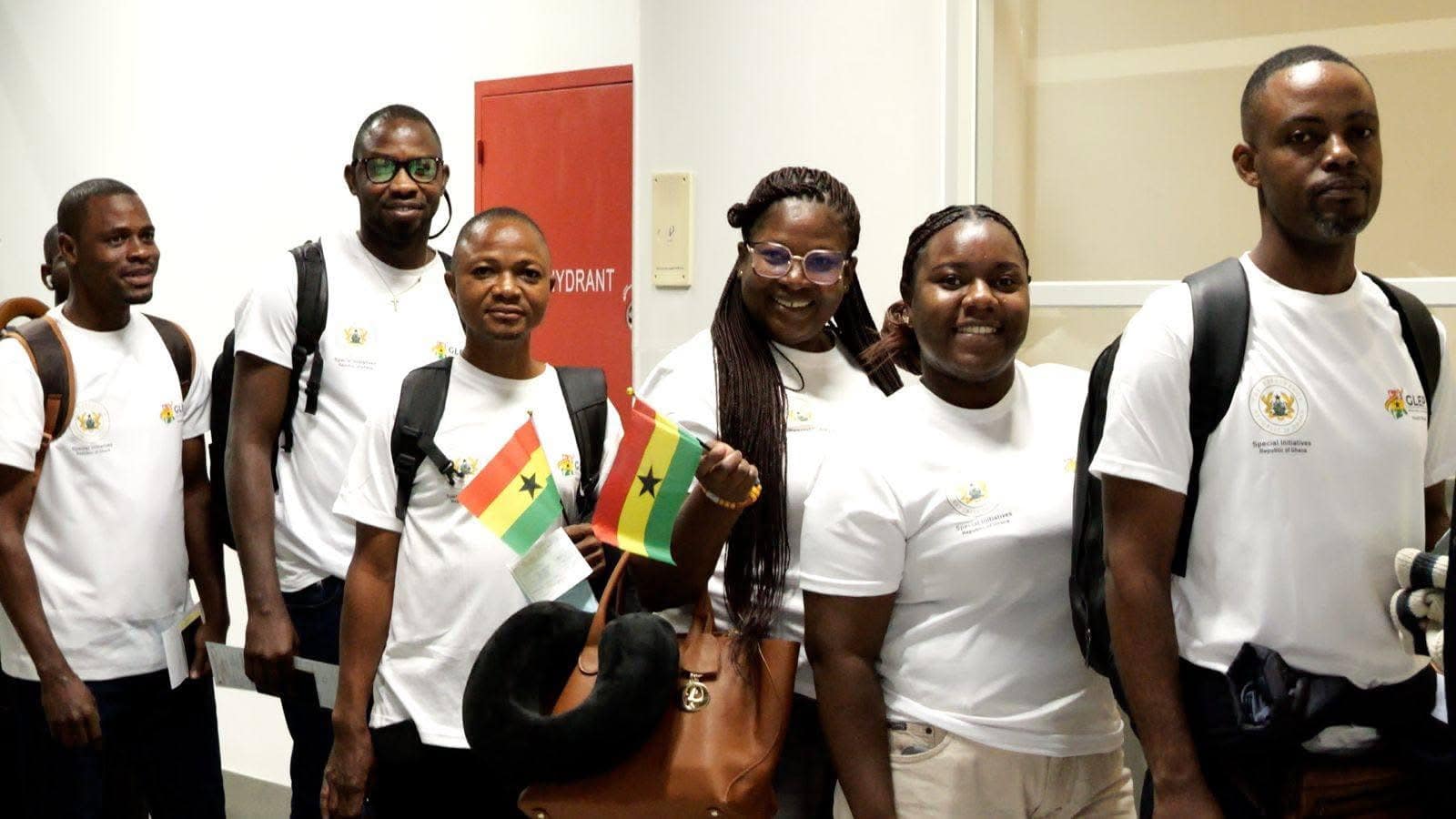



The nurses are expected to provide services at the Sir Lester Bird Medical Centre, community clinics across the island, and within the mental health sector over the next three years.

They arrived at the V. C. Bird International Airport and were greeted by Minister of Health, Sir Molwyn Joseph, Minister of State Michael Joseph, Permanent Secretary Stacey Gregg-Paige, Medical Director of the Sir Lester Bird Medical Centre Dr. Shivon Belle-Jarvis, and Nursing Director Jacqueline Jno Baptiste, along with other nurses and staff of the Ministry of Health.
Also in attendance were members of the Ghanaian delegation, including Samuel Appiahkubi, Technical Director in the Ministry of Special Initiatives; Nelson Ndebugre, Presidential Staffer in the Office of the President; and Gilbert Attipoe, Presidential Aide in the Office of the President of Ghana


Advertise with the mоѕt vіѕіtеd nеwѕ ѕіtе іn Antigua!
We offer fully customizable and flexible digital marketing packages.
Contact us at [email protected]





Let’s welcome our African brothers and sisters, keeping in mind that whether Cuba or Ghana, this is a process that will forever continue, since our local nurses, after obtaining the required knowledge and training needed, will continue to relocate to countries where salaries and benefits could never be matched by this government.
A wah so? Dem Antiguan simps min tink dat, an all oman nurse dey cum. De Antiguan ladies want fu taste some African kola nut, inna dem system too!
And de opportunist, egotistical, weatherCOCK Maulwyn Joseph dis him five piece polyester suit and necktie/noose fu African garments lakka him an original pan Africanist lakka C.L.R. James and Walter Rodney whose words and visions are coming to past, and de original Africans Kum dress in T-shirt!
Happy to see some MEN in the mix. Our Antiguan ladies will be taken care of properly. 😋 😋 😋
The Government of Antigua and Barbuda should be acknowledged for extending its hand to Ghana in an effort to address the ongoing nursing shortage. The reality is that the hospital is critically understaffed, and this directly affects the quality of care being delivered. One nurse managing 15–20 patients at a time is neither safe nor sustainable, and no healthcare system can thrive under those conditions.
However, while international recruitment may offer short-term relief, past experiences must be considered to avoid repeating the same cycle. When a large group of Vincentian nurses was previously recruited, only a small handful remain in Antigua and Barbuda today. The majority used the country as a stepping stone. Local nurses invested significant time and effort training them (sometimes from very basic clinical skills) only for many to later sit international examinations and migrate to the United States or the United Kingdom.
There is concern that this same pattern may repeat itself. It is hoped that the government has put enforceable bonding agreements and retention strategies in place, ensuring that Antigua and Barbuda does not once again become merely a training ground for nurses who leave as soon as opportunities arise elsewhere.
It must also be emphasized that Antiguan and Barbudan nurses are highly educated, competent, and continuously advancing their qualifications ; from diploma level to BSc, honours, and beyond. This professional growth is visible daily. These nurses should not be further burdened by having to carry an already overwhelmed system while simultaneously training overseas recruits who may eventually leave for “greener pastures.”
Many local nurses who have migrated did not do so out of disloyalty, but out of necessity. Salaries remain insufficient to meet basic life goals such as building or purchasing a home. Nurses are often told by financial institutions to seek joint applicants or even to “get a husband” in order to qualify for loans. These realities are well known to the Ministry and policymakers.
Additionally, working conditions within the hospital (ranging from staffing levels to management support) are frequently far from ideal. When nurses advocate for better conditions or fair compensation, responses such as “you can be replaced” only further erode morale and drive skilled professionals away.
International recruitment can be part of the solution, but it cannot replace the need to value, retain, and properly compensate local nurses. Past experiences offer clear lessons. The hope is that this time, those lessons are taken seriously for the sake of the healthcare system and the nurses who sustain it.
Also, there isn’t enough to retain the local nurses however over 100 Ghanaian nurses are ushered here how will they be sustained ? I am almost certain they won’t be working for free.
I want to be clear that my concern is not with the nurses as individuals, nor with pride in one’s country of origin — that is natural and understandable. However, context matters, and symbolism matters even more in public, state-linked situations.
The display of only Ghana’s national flag at an official arrival into Antigua and Barbuda felt inappropriate and, frankly, disrespectful to the host country. This was not a private moment or a cultural celebration; it was a public arrival tied to employment in Antigua and Barbuda’s public health system. In such circumstances, there should be a visible effort to acknowledge and respect the nation receiving you — whether through shared symbols, neutral protocol, or no flags at all.
My frustration is therefore less with the nurses themselves and more with the poor optics and lack of guidance surrounding their arrival. The government and organizers had a responsibility to manage this moment in a way that affirmed Antigua and Barbuda’s dignity, especially given public concern about the recruitment decision. That responsibility was not met.
You are welcome my brothers and sisters. Cant wait to see you guys around to mingle.
Your experience and expertise will make a real difference here.
Love that the pressure on our nurses will lessen! I hope our nurses gets atleast 2 weeks holiday to recover from the hard work n stress….
Well done to the government. Our nurses are overworked, and this kind of reinforcement is long overdue.
@Single Lady – Woanya me! WoanE adwuma! Fa/Gye! Fa wo dea bra!
MAN nf!!!!!!
It is encouraging to hear that about a hundred Ghanaian nurses have arrived in Antigua and Barbuda to help address understaffing in hospitals. Reading the public commentary around this move on migration, economics, and social dynamics has been quite interesting.
My hope is that this arrangement becomes truly mutually beneficial to all involved. There will naturally be mixed reactions: some people are excited about new relationships and friendships, others are curious about cultural exchange, some may be skeptical, and a few may even be resistant. Yet, there are also many who genuinely want this partnership to succeed and are committed to making it work.
I pray that all parties will work together in good faith, and that the people of Antigua and Barbuda will give these professionals the opportunity to serve and integrate. The early stages may come with challenges, but with patience and cooperation, progress will come.
To the Ghanaian nurses: keep your heads up. Stay resilient. Take time to understand the terrain, observe carefully, remain humble, learn continuously, and improve where necessary. If this spirit is maintained, I am confident that by the end of the three-year period, all parties will be celebrating meaningful achievements and shared succes
Comments are closed.