









Power, Timing, and Turbulence: Why the UPP Should Rethink Contesting Antigua and Barbuda’s Next Election by Brent Simon

There are moments in political history when the pursuit of power must be weighed against the consequences of acquiring it. Antigua and Barbuda may be approaching such a moment.
At first glance, the upcoming election cycle appears routine—another democratic exercise between the United Progressive Party (UPP) and the Antigua and Barbuda Labour Party (ALP). Yet beneath the surface, two destabilizing realities converge: a volatile international environment and a domestic political landscape strained by controversy.

To ignore either is naïve. To ignore both is reckless.

The administration led by Gaston Browne does not approach this election unburdened. It carries the weight of persistent allegations, public skepticism, and what many critics describe as a governance culture too frequently shadowed by controversy.
Whether one accepts or rejects these claims is almost beside the point. In politics, perception often functions as reality. A government widely viewed as scandal-ridden does not merely defend its record—it governs under a cloud that erodes public trust and institutional confidence.

Ordinarily, such conditions would present a clear opening for opposition forces.
Ordinarily.
However, Antigua and Barbuda does not operate in isolation. The escalating tensions involving Iran, coupled with an increasingly assertive and unpredictable global order, threaten to trigger cascading economic and political consequences far beyond the region.
Energy markets remain vulnerable. Supply chains are fragile. Financial systems are tightening. For small, import-dependent states, these are not abstract concerns—they are existential pressures.
Moreover, the Caribbean’s relationship with major powers has already revealed its asymmetry. During the tenure of Donald Trump, regional leaders were reminded—through visa policies, financial scrutiny, and diplomatic signaling—that sovereignty in small states is often constrained by external interests.
In such a context, governance becomes less about policy innovation and more about crisis management under limitation.
Herein lies the paradox.
The UPP faces a government weakened by controversy, yet simultaneously stands on the threshold of inheriting a potentially destabilizing global moment. Victory, under these conditions, may prove Pyrrhic.
Political history consistently demonstrates that administrations which assume office on the eve of crisis often suffer long-term damage. They inherit external shocks, absorb public frustration, and expend political capital addressing problems they did not create.
The result is predictable: rapid disillusionment, weakened governance capacity, and eventual electoral backlash.
The question, therefore, is not simply whether the UPP can win.
It is whether it should.
A controversial proposition emerges: the UPP should consider not contesting the election.
Such a move would defy conventional political logic, yet it would not be without strategic merit. Allowing the ALP to retain power would:
Consolidate accountability during a period of likely economic and geopolitical strain
Prevent the opposition from inheriting immediate crisis conditions
Provide space for organizational strengthening and policy refinement within the UPP
Reframe leadership as a function of timing and national interest, rather than perpetual contestation
This is not an argument for political abdication. It is an argument for political sequencing.
An equally uncomfortable dimension must be acknowledged.
Governments facing imminent global instability may, quietly, prefer electoral defeat. The burdens of crisis governance—rising costs, constrained fiscal space, unpopular decisions—carry significant political risk.
From this perspective, an opposition’s eagerness to assume power can inadvertently serve the strategic interests of the incumbent. Thus, the election becomes more than a contest for leadership; it becomes a transfer of liability.
This analysis challenges a deeply ingrained assumption: that elections must always be contested with maximum intensity, regardless of context.
Yet democracy is not weakened by strategic restraint. On the contrary, it may be strengthened when political actors demonstrate the capacity to prioritize national stability over immediate partisan gain.
In a small, vulnerable state, governance continuity during periods of global uncertainty can carry tangible advantages.
Antigua and Barbuda now stands at the intersection of domestic dissatisfaction and global instability. A scandal-encumbered government faces an opposition eager for change, even as external conditions threaten to complicate governance for whoever assumes office.
The intuitive response is confrontation.
The strategic response may be restraint.
If the coming years are defined by turbulence rather than transformation, then the central question is not who is most deserving of power—but who is best positioned to absorb the consequences of holding it.
In that light, the most radical demonstration of leadership may not be the pursuit of office…
…but the discipline to defer it.
Advertise with the mоѕt vіѕіtеd nеwѕ ѕіtе іn Antigua!
We offer fully customizable and flexible digital marketing packages.
Contact us at [email protected]




THEY GONNA GET A WHAPPING!!!!!
I want to know why foolishness is so prevalent in Antigua and Barbuda. You cannot miss it here. Pure unadulterated foolishness. May God help us!!!!
UPP is currently 15 percent in the polls , why should UPP contest with such DISMAL showing . UPP ,We are tired of you CUSSING Hon. Gaston Browne. UPP has no plan for Antigua. UPP is COMPLETELY dismantled. Your Leader has shown a DISGRACEFUL performance in Parliament last Friday. Jamale Pringle is STRESSED OUT. and is out of control. His Blood pressure must awfully HIGH.
ABLP. will win all. 17 seats.
In a country that still prides itself in the beliefs and use of the democratic system. I have never come across a more ridiculous idea and letter to the ANR editorial team in a long long time.
At times I’ve poked fun at the ABLP pushing for an autocracy in Antigua & Barbuda, but if the writer believes that the UPP shouldn’t even consider contesting this crucial General Election, anyone reading this will rightly believe that this person is well short of a sandwich in a picnic basket.
It’s so obvious that a higher member of the ABLP echelon is behind this utter tripe and hogwash
However, I did take this as a bit of light-hearted brevity 🤣🤣🤣
Nice one 👍🏾
… The sad thing for the country is that 99.9% of ABLP acolytes will believe that the UPP should step away from contesting this General Election, especially @FC, Less We Forget [He], PETE and more than likely Dr Dave Ray 🤣🤣🤣
Dem would love an autocratic state right here…
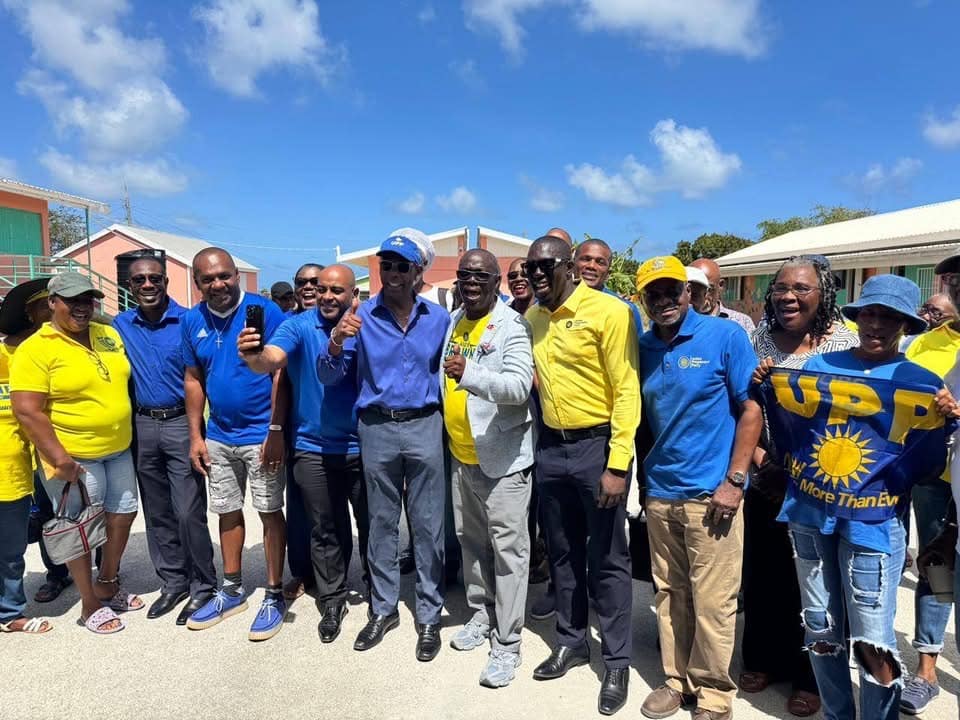
Why all UPP Candidates are.looking so UGLY and OLD ? Must be Their SINS. UPP can NEVER attract YOUNG , BEAUTIFUL , INTELLIGENT Candidates.
This article is TOTAL SHITTERY – similar to the state of the country and the ABLP.
Poor roads, unending water problems, pot holes more than roads, SO MANY UNSOLVED MURDERS, CRIME OUT OF CONTROL, RAMPANT CORRUPTION BY MINISTERS, TAKING DUNBARS AGRICULTURAL LANDS AND BUILDING PRIVATE HOTEL,LACK OF ACCOUNTABILITY……….
……..and the ILLS GO ON AND ON……..
BUT ANTIGUANS LOVE SUFFERING AND POVERTY>
THEY TREAT US LIKE DOGS EXCEPT FOR A FEW WEEKS DURING ELECTION SEASON when , ALL OF HEAVEN POURS OUT WITH BRIBES AND GOODIES, AND THE LOW LIFES LIKE AS WE ARE FORGET OUR PASS SUFFERINGS AND LACK OF DEVELOPMENT