






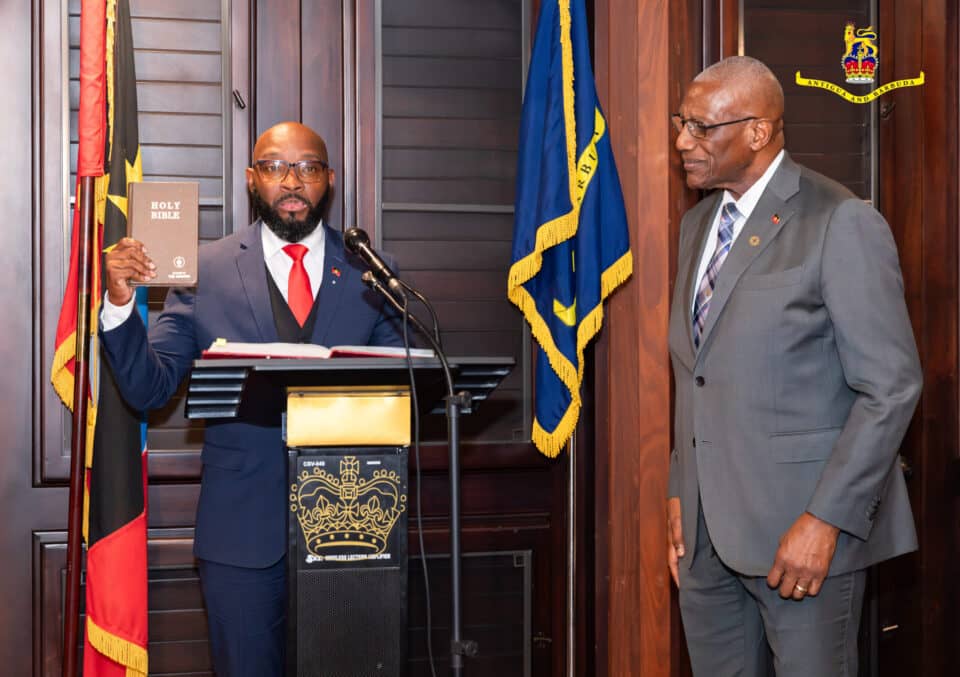



Beyond the Pledge: Constitutional Reform or the Quiet Consolidation of Power? By Brent Simon

The renewed discussion around amending the Pledge of Allegiance in Antigua and Barbuda has reopened a national conversation that is both necessary and overdue. Removing colonial references from our constitutional framework is not radical; it is logical. A sovereign nation should not require allegiance to a foreign monarch. That symbolic break with the past is long overdue.
But symbolism is not the danger facing our democracy. Concentrated power is.

If constitutional reform begins and ends with the pledge, it risks becoming a carefully staged gesture — patriotic on the surface, evasive underneath. Reform that does not confront the architecture of power is not reform at all. It is cosmetic nationalism.

The real crisis is not colonial language, but the most serious constitutional challenge confronting Antigua and Barbuda today is the erosion of the separation of powers and the unchecked expansion of executive authority. This is not an abstract legal concern. It is a practical, lived reality that affects Parliament, oversight bodies, local governance, the courts, and ultimately the citizen.
When the executive dominates the legislative process, marginalises dissent, weakens independent institutions, and governs through political loyalty rather than constitutional restraint, democracy does not disappear — it is simply replaced with a hollowed out version.

What emerges is not an overt dictatorship, but something more dangerous: a de facto dictatorship, where democratic forms remain intact while democratic accountability quietly collapses.
Changing the pledge does nothing to stop this.

Allegiance without limits is empty. An oath sworn to the nation, the Constitution, or the people has no meaning if power is not restrained by law, institutions, and culture. Allegiance must run in two directions. Officials pledge loyalty to the state, and the state must submit itself to constitutional limits. Without that balance: Parliament becomes compliant rather than independent. Oversight becomes selective rather than rigorous. Consultation becomes performative rather than meaningful. Dissent is treated as disloyalty, and most dangerous of all, Authority becomes concentrated, not accountable.
In such conditions, constitutional language becomes ornamental — impressive in ceremony, irrelevant in governance.
Reform must rebalance power not rebrand it. If Antigua and Barbuda is serious about constitutional reform, the pledge should be the starting point, not the headline. True reform must strengthen the separation of powers by:
Reinforcing parliamentary independence from executive dominance
Empowering oversight institutions with real autonomy and enforcement capacity
Insulating judicial and quasi-judicial bodies from political pressure
Protecting local governance structures from arbitrary override
Embedding public consultation as a democratic norm, not a courtesy
Without these safeguards, reform risks legitimising the very overreach it claims to correct.
Context matters and so does trust. Constitutional change does not occur in a vacuum. In a climate already marked by concerns over executive overreach, weakened institutional checks, and the concentration of decision-making, even well-intentioned reforms will be scrutinised — and rightly so. Removing a monarch’s name while governing without effective restraint is not decolonisation. It is repackaging authority.
This is not an accusation. It is a warning.
Unchecked power does not require malicious intent to become dangerous. It requires only opportunity and silence.
This moment is a bipartisan test of national maturity. The moment is also a test of political leadership on all sides. The government must resist the temptation to treat constitutional reform as a branding exercise or a partisan achievement. Reform done narrowly or hurriedly will deepen suspicion, not confidence. The opposition, for its part, must avoid reflexive resistance. Supporting decolonisation while demanding stronger democratic safeguards is not contradiction — it is statesmanship. The goal is not to protect colonial relics. It is to protect the people from the concentration of power in any one office, party, or personality. The debate is not about whether colonial references should be removed. They should.
The real question is this.
Who restrains power when power overreaches?
Until constitutional reform answers that question clearly and credibly, changes to the pledge — however well-meaning — risk becoming symbolic cover for a system drifting away from genuine democratic control. Antigua and Barbuda does not need louder declarations of allegiance. It needs stronger constitutional brakes.
And this moment demands the courage to say so — before symbolism replaces substance, and reform becomes consolidation by another name.
Advertise with the mоѕt vіѕіtеd nеwѕ ѕіtе іn Antigua!
We offer fully customizable and flexible digital marketing packages.
Contact us at [email protected]



I have read your piece with great interest and I must agree with your sentiment. I would however say that two things can be true at same time. Constitutional reforms to creat a greater check on consolidated power and our allegiance and linked to build a strong independent democracy and civil society, so to is accountability and integrity in public office.
They both serve a purpose for society’s good.
Symbolism matters and our past has shown us if we do emancipate ourselves from our mental slavery it would be hard to fully understand our role in building an accountable, true democratic society.
We often believe that mental slavery is about shackles and chains it is much deeper than that it is about our unwillingness to stand up and speak out for what is right.
It is not about your status in society but your love for your fellow man and your country as well.
So yes Mr. Simon I concur with your assessment and your article was well written 👏 👍 👌.
Keep speaking truth to power young sir
Brent Simon, I always enjoy reading your letters to the ANR editorial team.
Your writing is forthright and to the point, and most importantly leaves the reader to makeup their own minds on your viewpoints.
If you are an Antiguan, I am very proud to be associated with a fellow critical thinking and articulated countryman.
Blessings to you sir 🙏🏾
I like the article. It only corroborate my strong recommendation that the United Islands of Antigua and Barbuda in this era should not remove its ties with the United Kingdom. We do not have the competent, constitutionally and morally fair leaders in charge yet. It is a bad thing to change now. This is my warning. Can’t say I never warned you all.
I like the idea of moving away from the old outdated colonial system but it’s the only system that keeps our democracy in check….I don’t think Antigua is ready to become a Republic….
Comments are closed.