









Noise has become our national background music. Every week, sometimes every day, we are treated to another spectacle: a clever one-liner, a recycled accusation, a social media rant carefully engineered to trend for twenty four hours and then disappear. While the idiots, sycophants, and habitual followers laugh, share, and clap like seals at feeding time, what they fail to recognize is that the laughter itself is the distraction. And distractions, when repeated often enough, become dangerous.

So I say plainly: focus, my people.
An opposition is not meant to be a comedy troupe nor a chorus of professional complainers. In any healthy democracy, its role is demanding: scrutinize the government, identify weaknesses, and most importantly offer credible, workable alternatives. Criticism without solutions is not leadership. It is noise. And noise, no matter how loud, does not move a country forward.
To be fair, the opposition occasionally stumbles onto a real issue. Once a year, sometimes by accident, a valid concern emerges. There may be a sharp observation or a problem correctly identified. But the pattern is predictable. The analysis stops there. No framework. No policy proposal. No explanation of how things would be done differently, funded responsibly, or sustained over time. The issue is named, milked for outrage, and then abandoned.

That is not opposition politics. That is intellectual laziness.
Solutions require work. They require reading, research, consultation, and the discipline of thinking beyond slogans. They demand an understanding of economics, law, administration, and human behavior. They require humility and courage. This is where the opposition repeatedly collapses, not because issues are hard to find, but because the intellectual capacity to solve them is simply not there.

Instead, we are fed a steady diet of theatrics. Every development is framed as disaster. Every policy as doom. Every success is ignored or begrudgingly acknowledged before being drowned in sarcasm. This constant negativity is not insight. It is a strategy built on confusion, fatigue, and the hope that anger will replace serious inquiry.
But serious questions are exactly what citizens must ask.
What is the alternative plan?
How would you pay for it?
Who would implement it?
What evidence supports it?
What happens when things go wrong?
Silence usually follows.
That silence becomes louder when we move from abstract criticism to real issues that affect real people.
Take the roads. Everyone agrees they need improvement. That is not brilliance, that is observation. Where is the plan? Which roads first? What funding model? What timeline? Local contractors or foreign firms? What maintenance strategy prevents rebuilding the same road every five years? These are governance questions, yet all we hear is repetition, as though saying “the roads are bad” long enough will pour asphalt.
The same shallowness appears with water. Yes, interruptions frustrate people. But what is the long term solution? Expanded desalination? Infrastructure replacement? Partnerships? Conservation incentives? What would they have done differently when systems were aging and demand was rising? Again, no answers. Just noise and frustration masquerading as policy.
Then there is the economy, a word often invoked and rarely explained. Borrowing is criticized without discussing growth. Debt is mentioned without addressing investment. Hardship is warned of without proposing diversification strategies. What would they have done during global shocks? How would they stabilize revenue while funding healthcare, education, and social services? Would they cut, and where? Would they tax more, and who? These are adult questions, and adulthood is absent from the conversation.
Transparency is another favorite slogan, especially transparency everywhere except within their own house. Where is the internal accountability? Where are the clear leadership structures, and openly debated policy platforms? A party that struggles with transparency internally cannot convincingly promise it nationally.
Then there are the harder questions of real governance.
What would they have done if they were in power when controversial decisions arose? Would they have given back the boat? If they did, what then? Would the United States have objected? Would diplomatic relations suffer? How would that fallout be managed? What legal mechanisms would apply? What precedent would be set?
These are not games. These are the considerations leaders must weigh. Yet the opposition and their loudest labouring voices do not think past the first sentence that comes to mind. Their politics is reactive and emotional, not strategic or informed.
This is the core problem. Governance requires foresight. Opposition rhetoric requires only reaction.
Identifying problems is the lowest rung of political competence. Anyone can point at a crack in the wall. Leadership is knowing how to fix it without collapsing the structure. When an opposition cannot move beyond pointing, it exposes a deeper deficiency in vision.
This is why the constant mocking and cheap laughter should concern us. While followers repeat talking points, time passes. Opportunities are missed. Serious debates about education, healthcare, infrastructure, youth development, climate resilience, and economic stability are reduced to sound bites. A nation cannot be built on vibes and verbal gymnastics.
Focus, my people.
Matters are made worse when the opposition goes out of its way to tear down the image of the country itself, not because the country is failing, but because they resent who is leading it. In their desperation, they blur the line between opposing an administration and undermining a nation. Every international engagement is framed as embarrassment. Every partnership as scandal. Every diplomatic win as suspicion.
Then they wonder why countries like the United States observe us through a certain lens.
This is not coincidence. It is consequence.
International partners assess political maturity, cohesion, and institutional credibility. When chaos and doubt are exported, caution follows. You cannot spend years declaring crisis to the world and then be shocked when the world listens. Foreign governments read signals, not slogans.
This reveals an inability to separate patriotism from partisanship. You can oppose policy without sabotaging perception. Mature oppositions understand this balance. Ours does not.
Which leads to the unavoidable question: what would an opposition cabinet even look like?
Passion is not qualification. Loving sport is admirable, but a country cannot be run as though one individual can live forever in a single ministry. Governance requires breadth and depth, not just visibility.
And who would be entrusted with the Ministry of Finance? Are we to imagine Pringle in that role, overseeing fiscal policy, managing national debt, negotiating with international lenders, and steering the economy through uncertainty? This is not ceremonial. It is the nerve center of the state. Finance is not learned on the job. It demands technical competence, discipline, and foresight. Asking the question is not insult. It is seriousness.
And aunty Pearl needs no elaboration. Experience without evolution is not leadership. Nostalgia is not policy. Familiarity is not innovation.
This is not personal. It is structural. The opposition has failed to present a shadow cabinet that inspires confidence or readiness. A government is not a collection of personalities. It is a system. Systems collapse when built on noise instead of knowledge.
So when governance decisions are attacked, the public must ask: compared to what, to whom, and to which plan? Strip away the anger and theatrics and very little remains.
Focus, my people.
A nation cannot afford an opposition that confuses activism with administration or believes tearing down the house makes them better landlords. Leadership is not proven by who shouts the loudest, but by who thinks the deepest.
Until that changes, the opposition will remain entertainment for followers, a concern for serious thinkers, and a distraction from national development.
And distractions, as history teaches us, are always the enemy of progress.
The country is the best its ever been and a that bun them, look how many of their own parliamentarians have thriving businesses they themselves are beneficiaries.
focus my people don’t be fooled.
A Young Supporter
Advertise with the mоѕt vіѕіtеd nеwѕ ѕіtе іn Antigua!
We offer fully customizable and flexible digital marketing packages.
Contact us at [email protected]




If the opposition is this weak, why even “focus” on them?
Your weak diatribe about the UPP just shows how weak this governing body is, and how worried y’all are about the UPP.
If they are that weak and fragmented, why even waste articles after articles every weak on them?
Well we all know the answer. The problem is not how strong the UPP is, but how weak this governing body that we have now leading Antigua into this volatile future, that’s the worry here with many of us law abiding citizens.
Crime is through the roof, and here you are wasting time on the UPP, instead of finding ways to stop the guns and drugs that are peddling throughout Antigua like wild fire.
See this is the things and propaganda bullshit I hate about this Administration. They were put out there to clean up the island, and here they are 12 years later still blaming the damn UPP.
Get a life dude, and tackle the real issues that are plaguing Antigua. Cost of living and a crime problem that is making many heads spin, including your clueless AG and PM.
Bloody idiot. I’m just tired.
Enough of this bullshit.. where is the justice for the many who have been killed over the past 10 years or so, including a sitting MP?
That’s what I want to know.
Do you young supporter have any answers for us, any?
I thought not.
Go sit your ass down..for real..I’m tired of y’all now, tired.
Total baloney from the writer. But again, in a democracy he or she is entitled to their opinion.
What fascinates me at present is the growth of these anti opposition commentaries like this one. Something is afoot, and I can only imagine there’s a snap General Election in the air.
What else could it be?
Talk is cheap when in Opposition. This is so worldwide. For instance, Giselle and Lovell have been talking big about the US big stick in terms of Visas and the Cuban medical brigade. Talk is cheap. The country that has been taught ‘we are bigger than them’ is learning that we are just a dot in the sea. There is no independence, no matter how red in the face you get. Trump and his boss, Stephen Miller can pull flights from the US today if they so desire. then that would be the end of tourism. Or they can pull the cargo vessels that bring everything we survive on. And then we starve. THAT IS REALITY. Eli Fuller, who is already wealthy, can rant from now to next year about hotel developments on the beaches, but hundreds of students leave school annually looking for jobs. That is the plight of every government. THAT IS REALITY.
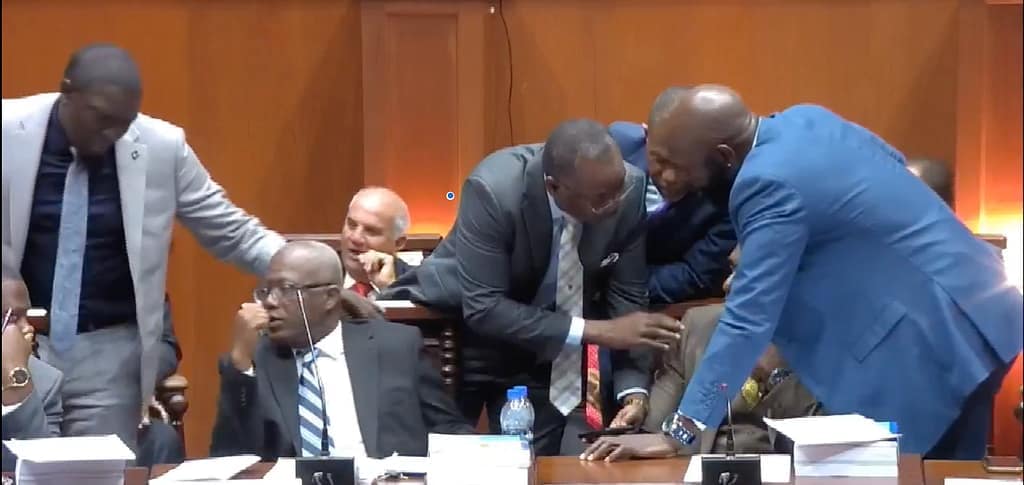
that picture says it all. Look at Pringle on.one side and.the other Richard Lewis supporters on the other. The gunman seems unbothered and not interested in aiding with Pringle. Could it be because he declared his hand too early by signing that letter supporting Richard?
Now he back peddled after an offer from Pringle’s PUPPET MASTER and has to FAKE THE PART OF BEING HIS DEPUTY
His heart and soul still with Team Richard.
I am tired of them too.
As soon as Gaston Browne bring in an artist they love, look how fast they pushing themselves to the front of the line to get a free ticket. Most of them don’t know a damn thing about anything. They won’t have any answers for you because they don’t know one damn thing except what is the latest iphone.
They tell you they do not listen to radio nor read the online paper nor talk politics. If they get the call tomorrow you would see how fast they trade in their “Focus, My People” for the latest SUV and the trip abroad.
If tomorrow there is a stand to be taken against the crap that is going on, you have to use a construction night light to look for them.
@Watta ting, I totally agree about pictures can tell a story (without words), especially in body language.
When Gaston Browne meets up with other Caribbean Leaders, I’ve noticed that 9 times out of 10 when he’s in attendance at some frivolous meeting (that could be easily conducted by Zoom), he’s avoided by 2-3 Ministerial colleagues, especially the Barbados 🇧🇧 Prime Minister Mia Mottley.
I think you are onto something here @Watta ting 😉
keep up the pressure on them JOAN. Continue to expose the weaklings like Shoogy and Serpent and tight brief Richard Lewis (according to.CROIF). And I agree with him that any chance Richard Lewis had at leadership is long gone.
Well Gaston haven’t I warn you from blogging under different name or penning an article ? You can try as hard as you can because the opposition shall not capitulate to your validation, you are a non entity that happen to be in a mafia organization that has become it’s head. Being a head of the ALP is no achievement, it’s not like the 1950’s of V. C Bird when real work was done against the colonials, this ALP now is a gang skill at embezzlement techniques.
Gaston Browne is a despicable human. He leads a government that is underperforming.
What are the factors causing the internal conflicts within the UPP, that allows ABLP to stay in place in spite of their failures.
Who leads these various fractions within the UPP? Why are the alliance lined up the way they are?
the UPP cannot even govern itself, so how can it.govern Antigua???
Comments are closed.