






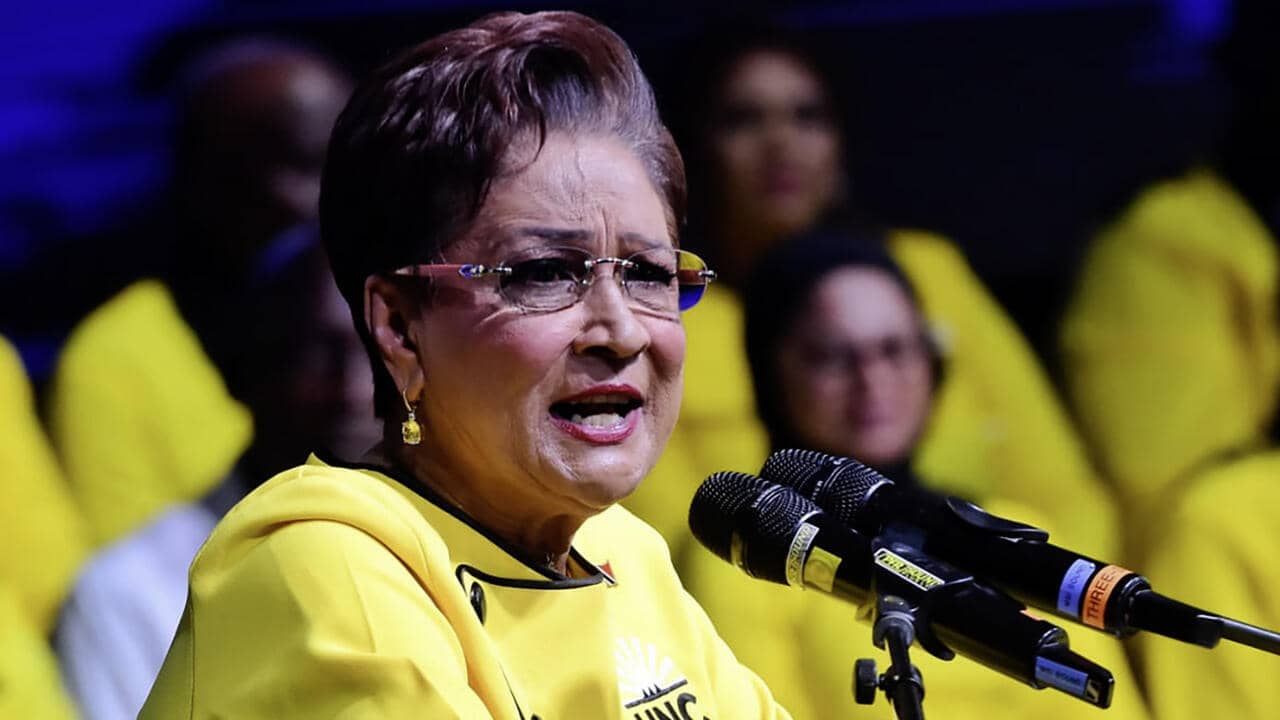


By any serious measure of political economy, the recent posture adopted by the leadership of Trinidad and Tobago toward Antigua and Barbuda is not merely diplomatically careless; it is economically presumptuous. It rests on a dangerous assumption, that Antigua and Barbuda is a dependent consumer with limited agency, rather than a rational actor in a regional marketplace whose purchasing power has long underwritten Trinidad and Tobago’s manufacturing sector.

Let us speak plainly, and with facts rather than sentiment.
For decades, Antigua and Barbuda—like many OECS states—has been a net importer of Trinidadian manufactured goods: food products, building materials, household items, beverages, and light industrial outputs.
Trinidad and Tobago’s manufacturing base, already under pressure from global competition and declining energy rents, relies heavily on guaranteed regional markets. Antigua and Barbuda is not a marginal customer; it is part of the economic scaffolding that keeps several Trinidadian firms viable.
To antagonize such a market while simultaneously deriding regional institutions that protect that very access is not strength. It is strategic incoherence.
Buying Power Is Leverage—Not Charity
Economic relationships are reciprocal. Antigua and Barbuda’s consumers do not purchase Trinidadian goods out of obligation or sentimentality; they do so because tariffs, historical trade patterns, and CARICOM preferences have made those goods competitive. The moment those political and diplomatic underpinnings are weakened, the commercial logic collapses with them.
In this context, Antigua and Barbuda must begin to think and act as a sovereign economic actor, not a passive participant in an asymmetrical relationship.
It is therefore entirely reasonable, indeed prudent, for the Government of Antigua and Barbuda to initiate a structured review of import taxation, particularly on goods where identical or functionally equivalent products are readily available from alternative markets. Where consumers can obtain comparable goods from extra-regional suppliers at lower cost or better quality, protective taxation in favor of a hostile or dismissive partner becomes economically irrational.
This is not retaliation. It is policy realism.
Tax Policy as Consumer Protection
Removing or reducing taxes on “like products” from non-traditional suppliers would:
* Lower consumer prices in a high-cost economy;
* Increase competition, forcing regional manufacturers to improve efficiency and pricing;
* Reduce artificial dependency on any single regional supplier;
* Strengthen Antigua and Barbuda’s negotiating position in future trade discussions.
In economic theory, this is a textbook case of welfare-enhancing liberalization in response to market distortion. In political practice, it is a signal that respect in diplomacy is inseparable from respect in trade.
CARICOM Is Not a One-Way Street
Regional integration was never designed to function as a shield for larger economies while smaller states absorb both the costs and the insults. CARICOM survives only if mutual benefit and mutual respect are preserved. When one state openly questions the value of the community while continuing to enjoy preferential access to its markets, it invites recalibration.
Antigua and Barbuda is not obliged to subsidize contempt.
A Strategic Moment for Leadership
The Prime Minister of Antigua and Barbuda would be acting well within reason—and in the clear interest of citizens—by directing the Ministry of Trade and Finance to:
* Identify product categories dominated by Trinidadian imports;
* Assess equivalent alternatives from Latin America, Asia, and North America;
* Remove or reduce import taxes on those alternatives where feasible;
* Allow the market, not political nostalgia, to determine outcomes.
Such a policy would not weaken Antigua and Barbuda. It would strengthen consumer sovereignty, discipline regional manufacturers, and reaffirm that economic respect must flow in both directions.
In the final analysis, nations, like firms, must respond to changed incentives. When a partner forgets the value of your market, the appropriate response is not protest alone, but policy.
And policy, grounded in economics rather than emotion, is the most damning response of all.
Son of the Soil
Advertise with the mоѕt vіѕіtеd nеwѕ ѕіtе іn Antigua!
We offer fully customizable and flexible digital marketing packages.
Contact us at [email protected]




Whatever boss….Anyways Trump gonna soon go boom boom down south are you over there or over here?
Wholeheartedly agree with the author. It is high time that Antigua and Barbuda recalibrate it’s position in Caricom as to what we offer, consume or pass off unto others. We must look again at our standpoint.
What does anything here have to do with Trinidad and Tobago telling ABLP government in Antigua and Barbuda they must prioritize democracy, human rights and public safety over the tyranny and dictatorships ABLP is supporting?
ABLP doesn’t even realize they have the weaker hand in the manufacturing and sale comparison being made in this article. Where on earth are your strategist, economist, and national security experts dunces?
I will be buying Trinidad and Tobago products and I will be supporting any all countries that supports democracy like Trinidad and Tobago unlike ABLP in Antigua and Barbuda.
There are tremendous customers for Trinidad manufacturing in New York, Jersey and the entire US, the Caribbean areas in the US and other areas too. Plus, we pay a premium to get them here. We a lot more than what ABLP pays.
I am pretty sure my purchase for these products will increase more now. When an ignorant political party forget the vital importance of democracy, and human rights, you happily accept their refusal to buy your products and sell them to people that have your morals and respect for democracy and it will be a lot more customers than the ABLP dictator supporters.
Trinidad and Tobago government played this one perfectly. ABLP, dunces. ABLP doesn’t even realize they have the weaker hand.
The author like many others react with emotions. Antigua and Barbuda as well as Trinidad and Tobago operate under the Revised Treaty of Chaguaramas, which sets out CSME obligations, trade rules, and dispute‑settlement.
The issues raised should not wait until there is a spat between two mercurial leaders who themselves are allowing their emotions to do the thinking.
The article is endemic of Antigua and Barbuda professionals as well as the entire Caribbean region where the issues are not raised and discussed until there is a quarrel of some sorts.
There goes any talk about compensating the CLICO investors in Antigua and Barbuda.
It takes a spat between the two country’s leaders to recognize that CARICOM needs to be reevaluated.
Jeez loweez..this thing didn’t even started out about the Caricom, and here are these people trying to twist the words of a woman to make it sounds like the woman came after Caricom.
This thing started with the PM of Trinidad standing up for her people, and she was attacked because she called out those who thought her actions didn’t line up with theirs.
Then GB and co jump on the bandwagon and tried to get his licks in, because he was directly called out.
Put on your big boy pants GB and tackle the real issue here. How on earth you and your so-called Embassador got caught with your pants down(according to you)?
How did you not see Trump coming from a long distance, especially when you took several meetings with Marco Rubio in Washington? Did you not see the energy in the room when that meeting was called?
We have the blind leading the blind here, and they are hell bent on crucifying those who have eyes to see and ears to hear.
This entire mess about the Visa restrictions from the US, stops at the feet of GB and co..go blame him, but instead we are hear trying to drum up hate for a woman that simply looked out for her people, something GB and his gang of idiots can certainly learn from.
Trump has punished GB and co for standing with Maduro, plain and simple. GB was asked to pick a side in those meetings, and he pretended he was some neutral party in the fight..well smart people like the US knew he was pretending and that he has leaned towards Venezuela, China, and other masters in recent times.
That’s why I always warned about who you take money or things from. If you take money from a drug dealer, even though you were not the one that sold the drugs, you have corrupted yourself as well. Fruits from the poisonous tree.
All the gift that China and Venezuela has been giving GB, some in secret and some in the wide open, are fruits from the poisonous tree.
China has no good intent for the Caribbean,and the US knows it. Chinese to not assimilate to no other culture, that’s the dangerous thing about them. And if y’all are stupid enough to thing they visit the carribean for its wonderful beaches, y’all are as gullible as it gets.
I will keep saying this..” the lesser of two evils”
That’s always the best choice. America is the best choice in these two evils, and GB chose wrong, and now he is paying for it.
@My Way Of Helping the most democratic thing a country can do for another country is not doing anything and let the people decide their faith. Not support foreign countries to take control that always been more repressive and cause more human rights abuse than the thing they said was evil in the first place.
Why do you think the people needs America to bomb Venezuela for them to be free? Especially when the country literally have delt with situations like this before.
@Islanman26 yes the statement she said can be seen as a treat on caricom because in situations like this individual countries do not have the power to fight bigger nations which is why we have CARICOM to have a union where we decide things as a collective and when one breaks away you gets chaos “1 from 10 leaves 0”.
Saying Chinese don’t accumulate to other cultures is just wrong immigration statistics shows from the immigration the first generation born in that country is already similar to the native and the second and third you can’t tell the difference between them and natives.
Saying US is the lesser of 2 evils or worst because the US does not believe in letter countries decide their own faith, like they opening saying they don’t want countries to trade with China when China don’t do that they don’t use military forces on countries that opposed them. In fact they are not even consistent with their “democracy” and “human rights” rhetoric when they literally have done abuse directly and indirectly from their war crimes and regime changes that have killed hundreds of thousands of not millions of people. But only when want to invade a country for finical benefits that’s when they have an issue not when it’s their allies that have the exact problems or worst.
Not only that GB haven’t even chosen a side it’s not even involved and is asking for peace in Caribbean Sea. Which is my opinion is the best option if you want a country to sort out it’s political issue the best option is to let the people of that country to solve it them selves, not invade and grab all their resources.
@young Communist.
I agree with some of your sentiments, but that opinion has not even being reached as yet to invade and bomb Venezuela.
All that was asked of Maduro is to stop sending drug/gun boats across the carribean that are funding gang members and criminal enterprises that directly hates the US.
That’s what took place..but to reach that far with your opinion and fears, is not what actually happened. The US never threatened to bomb Venezuela. A military build up is just a show of force, it’s not a declaration of war, that has to go through congress, and it hasn’t reached there yet.
I understand your point about letting them sort their issues out, but Maduro has directly threatened those who have taken the side of the US, including T&T, and that threat has to be met by someone, and so what if it’s the US?
This man is a defacto president, and one who has killed innocent people that has opposed him.
I’m not saying that you are down with that, and I’m not saying that the Donald is the Greatest thing that has happened to the US, but in this situation, something had to be done, and I guess the US were past the point of negotiations.
And yes, GB took a side.. The stance he took, not the one that he told the Antiguan people about, not the one where he said ” we are friends to all and enemy to none”, not that one, the one that he actually made when the commander of southcom visited him.
What you think that meaning was about, the weather?
Stop being naive dude..The American intelligence is one of the best in the world, don’t you think they know what was said or asked for in that meeting?
Why you think the Commander resigned all of a sudden?
All I’m saying, GB skills are lacking in the art of war and intelligence briefing, and now Antigua is paying for it..that’s on him, not the PM of T&T.
What she did, is what you call ” residual effect”.
The actions or lack there of, of GB and his foolish Embassador, put this entire thing in motion. Antigua is the one that got canceled from the American visa program, not T&T.
@young Communist.
I agree with some of your sentiments, but that opinion has not even being reached as yet to invade and bomb Venezuela.
All that was asked of Maduro is to stop sending drug/gun boats across the carribean that are funding gang members and criminal enterprises that directly hates the US.
That’s what took place..but to reach that far with your opinion and fears, is not what actually happened. The US never threatened to bomb Venezuela. A military build up is just a show of force, it’s not a declaration of war, that has to go through congress, and it hasn’t reached there yet.
I understand your point about letting them sort their issues out, but Maduro has directly threatened those who have taken the side of the US, including T&T, and that threat has to be met by someone, and so what if it’s the US?
This man is a defacto president, and one who has killed innocent people that has opposed him.
I’m not saying that you are down with that, and I’m not saying that the Donald is the Greatest thing that has happened to the US, but in this situation, something had to be done, and I guess the US were past the point of negotiations.
And yes, GB took a side.. The stance he took, not the one that he told the Antiguan people about, not the one where he said ” we are friends to all and enemy to none”, not that one, the one that he actually made when the commander of southcom visited him.
What you think that meaning was about, the weather?
Stop being naive dude..The American intelligence is one of the best in the world, don’t you think they know what was said or asked for in that meeting?
Why you think the Commander resigned all of a sudden?
All I’m saying, GB skills are lacking in the art of war and intelligence briefing, and now Antigua is paying for it..that’s on him, not the PM of T&T.
What she did, is what you call ” residual effect”.
The actions or lack there of, of GB and his foolish Embassador, put this entire thing in motion. Antigua is the one that got canceled from the American visa program, not T&T.
Comments are closed.