









By Dr. Nand C. Bardouille and Greg Quinn
With the Fiftieth Regular Meeting of the Conference of Heads of Government of the Caribbean Community (CARICOM) fast-approaching, an uncomfortable reality hangs over this high-profile moment in regional politics: The bloc — comprising 14 sovereign member states — has become mired in a clash of foreign policy outlooks.
What began on September 26, 2025 as a definitive signal of a foreign policy-related paradigm shift for Trinidad and Tobago has hardened since then. On that day, Trinidad and Tobago’s Prime Minister Kamla Persad-Bissessar addressed the general debate of the 80th Session of the General Assembly of the United Nations, inter alia, conveying new organizing principles of her government’s foreign policy approach.
CARICOM’s Divided House

Trinidad and Tobago now accommodates U.S. interventionist foreign policy, according to CARICOM insiders, raising concerns within the regional grouping’s fold. Behind closed doors, regional leaders question whether Port-of-Spain takes CARICOM’s prioritization of multilateral diplomacy and international regimes seriously.
As Port-of-Spain’s support for Washington’s interventionist logic in the Caribbean has only gotten stronger, mistrust of Trinidad and Tobago’s underlying foreign policy motives has grown.
By December 2025, Trinidad and Tobago’s relations with some of its sister CARICOM member states had devolved into a spiral of rhetorical confrontation.
It should come as no surprise that, having captured the headlines in recent months, foreign policy fractures within CARICOM are high on the agenda of the previously mentioned summit.
Given the sensitivity of the situation, CARICOM leaders will likely meet in caucus on this issue.
All eyes will be on the delegation of Trinidad and Tobago to ascertain, on the one hand, its level of representation and, on the other hand, how it will approach these deliberations.
Foreign Policy Strain
That said, the rise of the so-called “Donroe Doctrine” is influencing foreign policy outcomes across the board vis-à-vis the small states of CARICOM — forcing them to step away from long-held stances.
There are, for instance, concerns about Guyana’s commitment to CARICOM’s long-running goals and aims given U.S. dominance of oil and gas exploration in this South American country.
U.S. Secretary of State Marco Rubio has highlighted Guyana as a good and important place to do business. Exxon runs the only oil exploration currently operating in the country.
If you take a cold, hard look it is therefore difficult for Guyana to be too “independent” of the United States.
Not only is it highly dependent on the U.S. economically, but should anything happen (e.g. Venezuelan military action) it is only the U.S. who could be relied upon to come to its aid. European countries (e.g. the UK) with interests in the region have little in the way of assets therein and what they have prioritizes their Overseas Territories.
This puts Guyana in a quandary — a long-time supporter of CARICOM, now stuck between the proverbial rock and a hard place of continuing that support or being more obviously in the U.S. camp.
Now, the tension in question is playing out throughout all CARICOM nations over Cuba.
With Havana in Washington’s foreign policy crosshairs, the spotlight has fallen on these countries’ recent diplomatic signals in relation to Cuba.
Cuba has been a long-standing friend of CARICOM, providing medical and educational support — a key vehicle for Cuban soft power. On many occasions, it has also supported disaster recovery.
In return, CARICOM has consistently and strongly called for an end to U.S. economic sanctions and the economic embargo against Cuba. Always as a matter of pride and principle.
Yet there has been little in the way of response to the U.S. oil blockade of Cuba.
The Trinidad and Tobago Guardian recently highlighted the existence of more direct pressure from the United States, reporting the following comments by Saint Lucia Prime Minister Philip J. Pierre: “Many of our doctors got trained in Cuba, and now the great United States has said we can’t do that any longer.”
In what WiredJa called “diplomatic gaslighting”, the U.S. Embassy accredited to Barbados reacted by stating: “The United States has not recently talked to St Lucia about international education and respects countries’ sovereign decisions regarding the education of their citizens.”
Who to believe?
Elsewhere, Guyana has formally ended its bilateral medical cooperation agreement with Cuba. Guyanese authorities contend this decision was not influenced by the United States, claiming there was no specific reason for the termination.
Guyana is hardly the first CARICOM member state to do an about-turn and end Cuban-backed medical cooperation, which the U.S. administration takes aim at. Having spent the better part of 2025 assertively defending its long-standing medical partnership with Cuba, in the face of mounting U.S. diplomatic pressure, Antigua and Barbuda abruptly terminated it late last year.
If nothing, there is a pattern of CARICOM countries changing their foreign policy-related approach to Cuba, either because of U.S. pressure or because of a fear of it.
Fundamentally, the “Donroe Doctrine” is placing significant strain on CARICOM’s foreign policy ethos.
Need for a Deep Reset
Assessments about the “Donroe Doctrine” and this expansion of U.S. direct influence into the Caribbean will partly frame the upcoming CARICOM summit’s deliberations, bringing into focus: (i) the bloc’s disconnect with Trinidad and Tobago on this doctrine; and (ii) respective member states’ reactions to ‘America First’ unilateralism.
Accordingly, regional foreign policy tensions will loom large in this high-level meeting’s plenary and corridor discussions. This is a function of the stakes involved — amid regional political strains and this period of geopolitical tumult within international politics.
As the convening date (i.e. February 24 to 27) of this summit draws nearer, the powers that be continue to press behind the scenes for a way forward to address the ‘clash’ under reference.
They are painfully aware that this issue has cast a shadow over regional politics and that making headway on the matter has the potential to transform such politics, which have hit a low point.
Put differently, regional politics ought to enable integration-related institutions and processes to take steps toward — rather than away from — the realization of a coherent vision of regionalism qua regional unity.
Yet, it is unclear whether such efforts have paid off.
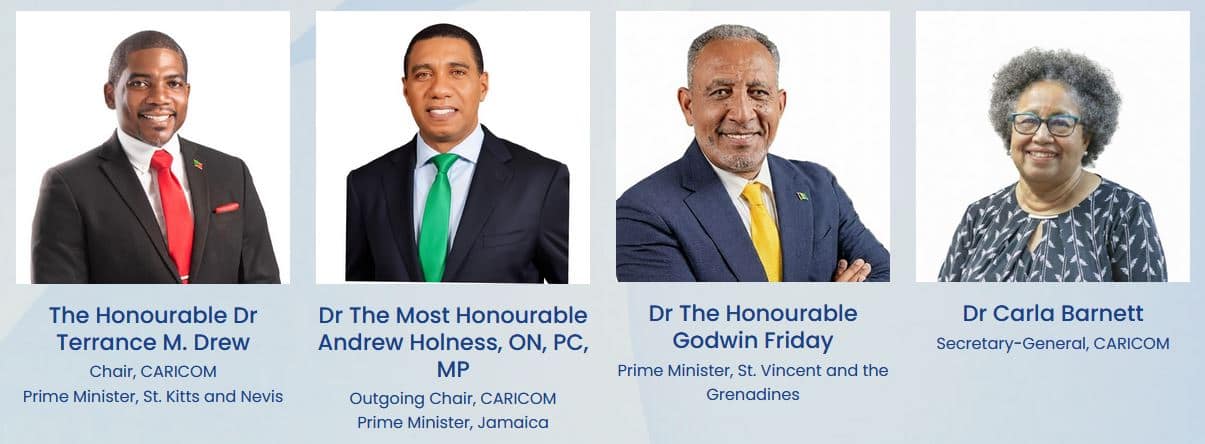
In fairness to CARICOM chair Terrance Drew’s recent face-to-face discussions with regional leaders, which included a meeting with Persad-Bissessar just last month, positive signs are readily apparent. Following Drew’s meeting with Persad-Bissessar, Trinidad and Tobago’s Prime Minister changed her tune on the bloc.
Up until that engagement — as one of the most important regional leaders of this moment — she had shown little interest in CARICOM.
As things stand, though, there is need for a deep reset in respect of political relations. In this regard, CARICOM has no time to lose.
In terms of progress toward this course of action, a lot is riding on the CARICOM summit this month.
Will CARICOM’s foreign policy turning point begin in earnest with this summit? We will have to wait and see.
________
Nand C. Bardouille, Ph.D., is the manager of The Diplomatic Academy of the Caribbean in the Institute of International Relations at The University of the West Indies (The UWI) St. Augustine Campus, Republic of Trinidad and Tobago. The views expressed here are his own.
Greg Quinn, OBE is a former British career diplomat, who was High Commissioner to Guyana from 2015 to 2020. He now runs his own government relations, business development and crisis management consultancy: Aodhan Consultancy Ltd (www.aodhaninc.co.uk).
This article was first published by the Jamaica Gleaner on February 16, 2026.
Advertise with the mоѕt vіѕіtеd nеwѕ ѕіtе іn Antigua!
We offer fully customizable and flexible digital marketing packages.
Contact us at [email protected]



WHAT THE HELL…! … BRER ANANCY: …THE QUIBBLING TWIN’
STUNNING INTELLECTUAL STUPIDITY (SIS)
***
INTELLECTUAL FERMENTATION OF FRACTIOUS RELATIONS
Clearly, an attempt at engaging in ‘…AN INTELLECTUAL FERMENTATION OF FRATIOUS RELATIONS’ with the ‘…MEMBERSHIP OF CARICOM.’
***
YES! …WAIT: …WATCH AND SEE. Last Paragraph of the article.
***
INTELLECTUALITY -FREE EXPRESSION:
None may deny the authors’ ‘…INTELLECTUALITY:
None may deny their right to ‘…FREE EXPRESSION.’
***
COMMONALITY OF UNDERSTANDING
Unfortunately, their ‘…INTELLECT’ appears not to have been properly guided:to
(i) ‘…A COMMONALITY OF UNDERSTANDING: nor of
(ii) …THAT CONSTITUTING NATIONAL SOVEREIGNTY: nor
(iii) …KNOWLEDGE OF THE DIFFERENCE BETWEEN:
(iv) …NATIONAL GOVERNMENTS: and
(v) …REGIONAL ORGANIZIONS: that
***
NOW: ‘…BE IT CARICOM OR THE ORGANIZATION OF EASTERN CARIBBEAN STATES (OECS):
(vi) …NEITHER CAN DETERMINE: what
(a) …DOMESTIC POLICIES: or
(b) …FOREIGN POLICIES: and
(c) …THAT EVEN WITH ‘…INTELLECTUALLY CRAFTED COMMUNIQUE: none
(viii) …REPRESENTS THE INTERESTS- DOMESTIC OR FOREIGN: neither of
(ix) …THE MEMBERS OF CARICOM NOR OECS.’
***
That being purportedly authored, and published in ‘ANR,’ as it pertains to:
(a) ‘….KAMLA PERSAD-BISSESSAR’S SUGGESTED ‘REPUBLIC NATION OF TRINIDAD AND TOBAGO ALIGNMENT: with
(b) …THE UNITED STATES OF AMERICA: and
(c) …THE REPUBLIC OF GUYANA CESSATION OF THE ‘…MEDICAL PROGRAMME WITH ‘…SISTER CARIBBEAN NATION CUBA, AS WELL: as
(d) …THE PHILLIP J. PIERRE SOVEREIGN NATION OF ST. LUCIA: and
(e) …THE GASTON BROWNE SOVEREIGN NATION OF ANTIGUA AND BARBUDA,’ seemed to have been done with ‘…INTELLECTUAL ULTERIOR MOTIVE.’
***
It shall have been clear to that with this peiece: of
(a) ‘…STUNNING INTELLECTUALITY STUPIDITY: that
(b) ‘…The CARIBBEAN COMMUNITY (CARICOM):has
(c) …NEVER BEEN THE ‘…MOUTH ORGAN: and
(d) ‘…COULD NEVER BEV THE DECISION-MAKING ORGANIZATION FOR ANY OF THESE REGIONAL NATIONS.’
***
WHAT THE HELL…!
***
LIKENED TO THE ‘…FORMER BRITISH CAREER DIPLOMAT- HIGH COMMISSIONER TO GUYANA: neither for
‘(i) ‘…THE BRITISH GOVERNMENT: nor
(ii) …THE REPUBLIC OF GUYANA,’ HE, AS A ‘DIPLOMAT,’ COULD NEVER HAVE TAKEN DECISIONS: on
(iii) …THEN HER MAJESTY’S GOVERNMENT.’
***
WHAT THE HELL…!
***
Comments are closed.