









CLICK HERE TO JOIN OUR WHAT’S APP GROUP

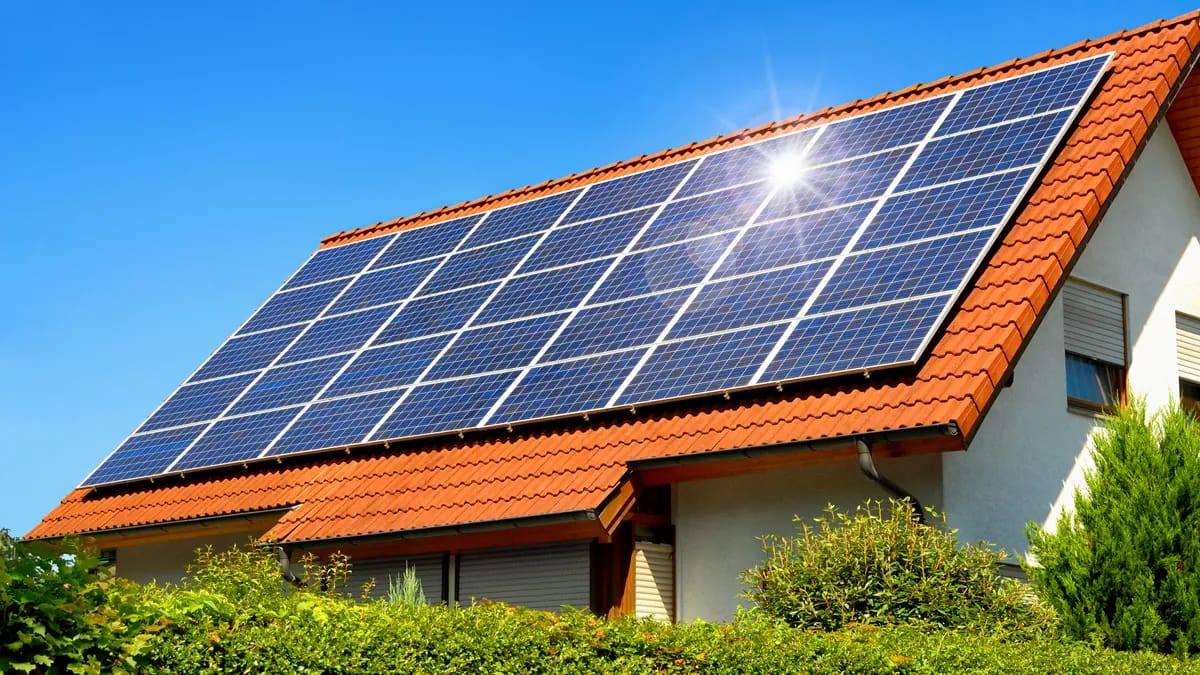
Energy Minister Melford Nicholas has signalled that the government will introduce new limits on rooftop solar installations as it works to balance the growth of renewable energy with the stability of national electricity revenues.
Speaking ahead of the upcoming Renewable Energy Symposium, Nicholas said homeowners interested in installing solar systems will still be encouraged to invest, but a cap will be necessary in the initial phase.

He confirmed that the government intends to set a 5kW limit on residential solar capacity, noting that this threshold is designed to prevent a significant loss of revenue for the state-owned utility while broader renewable plans are being developed.

“We want to do business with persons who wish to make the investment in their own solar rooftops,” he said. “But we’re going to have to put some limits in place… We do not want to impair revenues to such an extent that it puts us in peril.”
Nicholas added that the government is also planning utility-scale renewable energy projects, details of which will be presented at the symposium.

Despite the cap, he stressed that households will still be able to use battery storage systems and inverters, allowing them to manage their own energy use more efficiently.
The minister said the phased approach will help the government expand renewable energy responsibly while ensuring the electricity system remains financially secure.

CLICK HERE TO JOIN OUR WHAT’S APP GROUP
CLICK HERE TO JOIN OUR WHAT’S APP GROUP
CLICK HERE TO JOIN OUR WHAT’S APP GROUP
CLICK HERE TO JOIN OUR WHAT’S APP GROUP
CLICK HERE TO JOIN OUR WHAT’S APP GROUP
CLICK HERE TO JOIN OUR WHAT’S APP GROUP
CLICK HERE TO JOIN OUR WHAT’S APP GROUP
CLICK HERE TO JOIN OUR WHAT’S APP GROUP
CLICK HERE TO JOIN OUR WHAT’S APP GROUP
CLICK HERE TO JOIN OUR WHAT’S APP GROUP
CLICK HERE TO JOIN OUR WHAT’S APP GROUP
Advertise with the mоѕt vіѕіtеd nеwѕ ѕіtе іn Antigua!
We offer fully customizable and flexible digital marketing packages.
Contact us at [email protected]




Soon from now we might hear 50 gallon cap on water tank
😂. You just have to laugh.
I thought GB wanted to reduce Antigua’s carbon footprint?
Oh well, so much for “Climate Justice”. 😂.
Stop Bamboozling the people GB.. 😂
After ABST, all the other taxes, you stupid ass want to limit this so they can be over charged by APUA.
Definitely not voting for you.
As I said about the hypocritical government claiming to be climate cautious they limit personal use of solar systems on the people who can afford to do so by not even allowing people to have the freedom of having batteries to run their homes and now limiting inverter size.
This makes solar feedback to grid basically useless because average homes consumes more than that on a full limit and the most power demand comes during the night when people are more likely to be home. Which makes no sense if the government truly want the grid to be green, we don’t even have a green energy that is contentious like the geothermal project in Dominica much less the solar instructor and batteries to store power. I’m sure it’s totally fine moving to LNG and we will have renewable grid by 2035 or what ever was the year that was last said.
What a slap in the face
A comment from the UK. Too much solar makes the grid unstable and can cause power cuts. It’s best to introduce it slowly whilst the electricity board learns how to deal with it.
Another problem is that if everyone is generating their own power but expecting APUA to supply power on hot sticky nights someone has to pay APUA to keep the power generation capacity working.
Please let me advise those thinking about a solar system. It is not efficient. If you amortize the cost of the panels, batteries and inverter you will realize that it’s not cost effective compared to grid power. A good bank of batteries is upward of USD$5,000.00 and last about 5 years with good management. Panels eventually lose their efficiency as well. The system has a life span which will eventually need replacing. Trust me I lived off grid for 17 years and had to run my generator more than I wished to support my solar system. IT IS NOT WORTH IT.
Need a cap on government corruption. You piece of 💩
You mean “to prevent a significant loss of revenue to Hadeed power plant”? I don’t think APUA run generators any more
It is nothing new that the APUA will do anything to maintain their monopoly. Competition benefits the citizens but not the suits in that incompetent government agency.
My current system in Antigua is over 5kW. My Lithium-ion batteries have a lifespan of 10-15 years. My future house there will have a slightly bigger system with a different battery type; I don’t care what the cartel members at the APUA have to say.
For me, it has been a necessary investment since the APUA cannot be relied upon to generate and distribute power on a consistent basis.
@hadeed you mean, APUA have a contract to sell them a certain amount of power he gets the money weather APUA need that capacity or not
@Young Antiguan Communist – Thanks for the info
Comments are closed.