






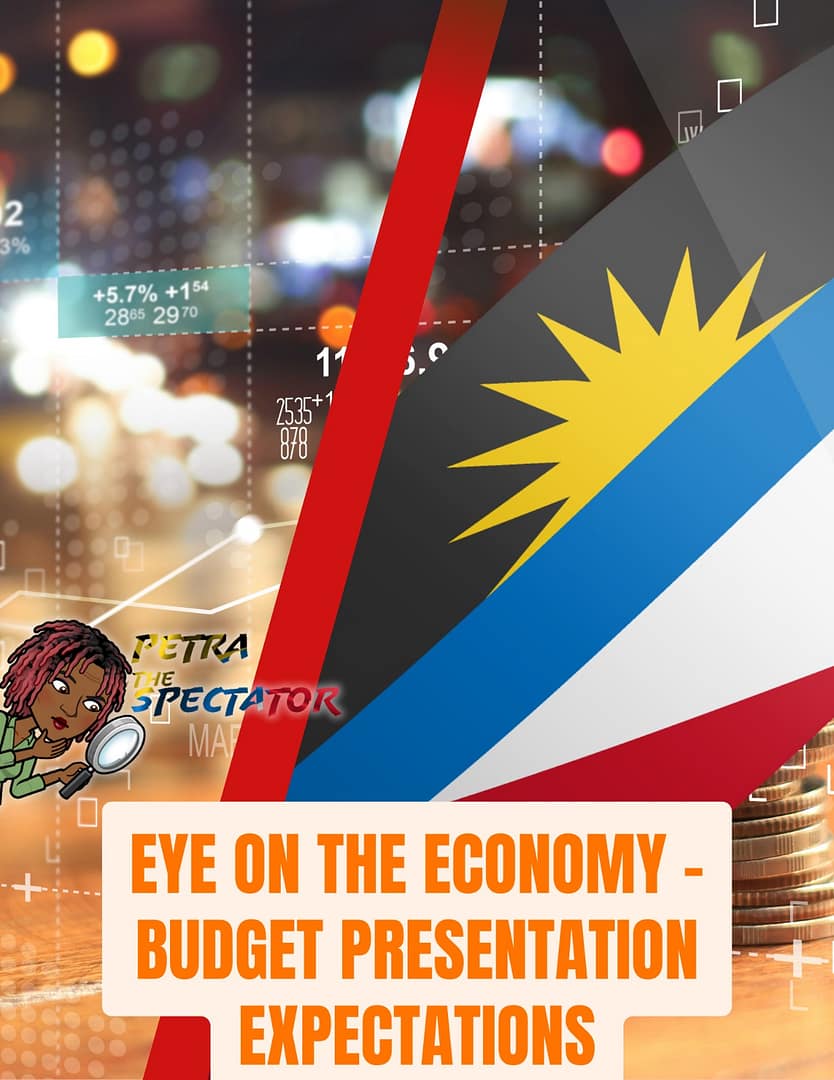


Eye On The Economy: Beyond the Throne Speech, Prospects
for Budget 2026
Petra Williams
www.petrathespectator.com

Understanding the Westminster Sequence: Vision vs. Execution
In the Westminster parliamentary tradition, the Throne Speech and the Budget Speech
serve distinct but complementary purposes. The Throne Speech, delivered by the Head of
State but authored by the government, sets out the broad national direction: its
aspirations, legislative intentions, and overarching policy pillars. It is deliberately high-
level, offering the country a sense of what the government intends to pursue and why
these aims align with a wider national development narrative.
The Budget Speech, by contrast, is the government’s operational roadmap. Delivered by
the Minister of Finance, it explains how the priorities expressed in the Throne Speech
will be financed, sequenced, and implemented across the fiscal year. Where the Throne
Speech sets the “what,” the Budget must provide the “how.”
A Sharper, More Disciplined Throne Speech
This year’s Throne Speech distinguished itself from recent iterations by being sharper,
more focused, and less elaborate. Recognising that the public has grown weary of hearing
the same promises recycled, the Speech concentrated on longstanding national priorities:
strengthening water and road infrastructure, revitalising LIAT and the wider aviation
economy, deepening institutional reform, accelerating Barbuda’s development, and
expanding the UWI Five Islands Campus. The emphasis on governance, resilience, and
modernization was evident throughout. Yet, as with all Throne Speeches, these
declarations remain conceptual until matched by the capacity to finance and implement
them, elements that the Budget Presentation should address directly.

From Vision to Delivery: The Shift Toward Budget 2026
Transitioning from the Throne Speech to the 2026 Budget Presentation represents a shift
from vision to execution. The Throne Speech outlined national ambitions, but the Budget
must now articulate the mechanisms to bring them to life. Citizens, businesses, and
analysts will be listening not only for allocations, but for clarity on timelines,
performance targets, compliance measures, and the institutional reforms that must anchor
delivery.
The Budget must show how the administration intends to manage inflationary pressures,
strengthen the revenue base, expand the services economy, and ensure that national
progress continues to translate into meaningful improvements in people’s lives. The
foundation has been laid; this presentation should ‘run up more blocks.

Infrastructure Priorities: Water and Roads
Water infrastructure remains a top public concern. While desalination output has
improved and complaints have declined, reliability remains uneven. The Budget will
need to reaffirm sustained investment in production, storage, transmission, and
distribution—supported by clear timelines for ongoing pipeline changes and network
upgrades. Expectations are high as APUA modernises its network with transparent
performance indicators.
Road rehabilitation is also moving forward, but at a slower pace than public demand.
Questions persist regarding the EC$100 million road bond announced in February 2025.
Silence around its utilisation—especially following legislative amendments increasing
vehicle registration fees to support it—continues to raise concerns. The Budget must
address this directly to rebuild trust.
Institutional Reform: The Unfinished Work of Governance
Institutional reform remains the ultimate test of government capacity. For years, reforms
in Customs, Inland Revenue, Immigration, and regulatory agencies have been
undermined by personnel reshuffling rather than systemic change. The Budget must
therefore invest in modernisation, compliance tools, and a professional reform unit
capable of advancing the Cabinet’s long-declared, mostly lip-service transformation
agenda. Without this foundation, other reforms will struggle to take root.

Digital Government: Moving Beyond Lip Service
Digitisation has been a recurring promise with limited delivery. While full digital
transformation may still be some distance away, the Budget should outline a measurable,
incremental plan that improves service delivery, efficiency, and accessibility. Citizens are
looking for progress, not platitudes.
Aviation and LIAT: Opportunity and Unresolved Obligations
Aviation underpins tourism, regional mobility, and the broader services economy. This
year’s Budget must clarify Antigua and Barbuda’s financial commitment to the
restructured LIAT (LIAT Air) and outline any plans to expand aviation services such as
maintenance, repair, overhaul (MRO), crew training, and transit operations. These areas
carry substantial revenue and job-creation potential.
Still unresolved is the long-standing issue of severance for former LIAT employees, a
matter expected to be addressed in the Budget Presentation.

Cost of Living and Inflation: Managing Household Pressures
Cost of living will be another defining issue. Imported inflation remains above five
percent, and the government’s decision to zero-rate import duties on selected food items
under the COTED-supported CET suspension must be fully reflected in the Budget.
Reduced CIF values will translate into lower ABST and Revenue Recovery Charge
receipts, requiring careful fiscal balancing.
The ongoing Minimum Wage Review, launched in October 2025, may also feature,
though the Committee’s work is ongoing.
Social Services and an Ageing Population: Strengthening the Safety Net
A significant area requiring greater attention in Budget 2026 is the state of social
services, particularly given the growth of Antigua and Barbuda’s elderly population and
the widening vulnerabilities due to a myriad of factors. Life expectancy has increased
and chronic illnesses are more prevalent, leading to a larger share of seniors relying on
public assistance, healthcare, and community-based support systems.
The Budget will be closely scrutinised for commitments to elderly care, including home-
based care programmes, regulating policies for senior care facilities, expanded
community health outreach, and stronger coordination between social services and public
health agencies. Many seniors live on fixed incomes that have not kept pace with rising
prices for food, medication, utilities, and transportation. Strengthening pensions, medical
subsidies, transportation support, and community programmes will prove vital to
safeguarding dignity and wellbeing.
Equally important are supports for vulnerable groups: low-income families, persons with
disabilities, unemployed youth, single-parent households, individuals with mental health
challenges, and individuals still recovering from climate-related shocks. The Budget must
clarify how existing programmes (Board of Guardian assistance, utility subsidies, school
meal support, emergency relief, new mental health facility) will be financed, and whether
expansions or redesigns are planned.
In a small island developing state, social protection must be understood as part of the
wider resilience infrastructure. It determines how deeply shocks are felt and how quickly
families and communities can recover.
Barbuda: Development, Safeguards, and Equity
Barbuda’s development remains a key part of the national strategy. As the sister island
continues to expand as an economic hub, the Budget is expected to outline financial
support and private-sector partnerships to grow infrastructure. Commitments to
environmental protection, administrative upgrades, and sustainable tourism must go
alongside this. Balancing growth with community and ecological care is crucial.
Human Capital: Advancing Education and Skills
Education, particularly the expansion of the UWI Five Islands Campus, upgrades to
government secondary schools, and continued professional development for teachers,
remains foundational to national development. The Budget is expected to support
program expansion, research and development, infrastructure upgrades, and access to
scholarships. Strengthening UWI Five Islands reinforces Antigua and Barbuda’s ambition
to be a leader in innovation and knowledge production.
Growth Drivers: CHOGM, Conferences, and Sports Tourism
Positive economic developments will strongly influence Budget 2026. Hosting CHOGM
2026 will generate significant economic activity across hospitality, transport, retail,
security, and events while boosting Antigua and Barbuda’s global profile and investment
attractiveness.
A cluster of regional and international conferences will further expand tourism receipts,
hotel occupancy, ABST collections, and services-sector earnings. Sports tourism, driven
by CPL, the Antigua & Barbuda Falcons, and expanded activities at the WICB
headquarters, continues to attract high-yield visitors, increase local spending, and gain
powerful global media exposure.
Resilience: The Defining Principle of Caribbean Survival
Antigua and Barbuda was spared the worst of this year’s hurricane season, but
devastation across the region underscored that safety is never guaranteed. Hurricane
Irma’s destruction of Barbuda in 2017 and the recent Category 5 Hurricane Melissa in
Jamaica are stark reminders of escalating climate risk.
The Budget must embed climate readiness as a central pillar of economic planning.
Infrastructure strengthening, resilient public systems, and early-response capacity must
be prioritized despite limited financial resources. Resilience is not abstract; it is
economic survival and social protection intertwined.
The Final Measure: Delivery, Not Declaration
Ultimately, the Budget will determine whether the direction set in the Throne Speech is
matched by financing, sequencing, and institutional capacity. Citizens are not looking for
repetition; they are looking for proof of progress. Water reliability, road conditions, cost-
of-living relief, institutional reform, aviation development, and the growth of tourism are
just some of the defining pressure points of 2026.
The credibility of Budget 2026 will rest on whether it can translate national ambition into
measurable, shared, and sustainable improvements in the lives of Antiguans and
Barbudans. The work continues, and expectations are high!
Petra Williams is a Caribbean special features writer whose work is featured regularly across
Antigua and Barbuda’s media and occasionally throughout the wider region. As founder of
petrathespectator.com and publisher of The Spectator magazine, she blends history, culture, and
economic insight into stories that celebrate and connect her twin-island home.
Advertise with the mоѕt vіѕіtеd nеwѕ ѕіtе іn Antigua!
We offer fully customizable and flexible digital marketing packages.
Contact us at [email protected]



I will be glued to my radio
I am sure it will be a replay of the same budgets of the past 3 years.
Usually a replay of the past 3 years.
Comments are closed.