






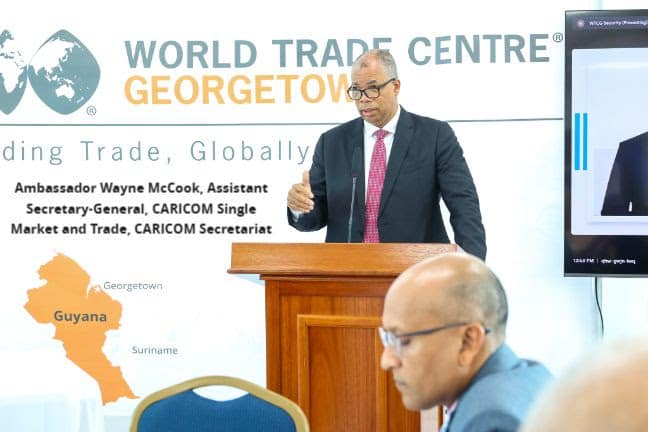



A senior Caribbean Community (CARICOM) official has positioned deeper regional integration as a strategic response to an increasingly fragmented and uncertain global trade environment, as global rules-based systems weaken and economic nationalism intensifies.
Ambassador Wayne McCook, Assistant Secretary-General, CARICOM Single Market and Trade, was a panelist discussing Prospects for International Trade in 2026 in the Context of the Changing Global Geopolitical and Economic Landscape – Impact on Trade and the Challenges and Opportunities for the Caribbean and Latin America. The discussion was held on Wednesday, 28 January, at the World Trade Centre in Georgetown, Guyana.
Contextualising the Region’s position, Amb. McCook said: “For our Region, the scars of the immediate past are visible. The devastating passage of Hurricane Melissa encapsulated the dual challenge we face: the existential threat of climate change and the inherent economic vulnerabilities of our CARICOM Member States. Simultaneously, we have navigated dramatic shifts in global trade, driven largely by an intensified “America First” trade policy that has significantly impacted our exports, value chains and supply chains through a suite of unprecedented tariff measures.”
Against the background of what he described as “a truly tumultuous 2025” for international and regional trade, Amb. McCook highlighted CARICOM’s “oneness” and its resilience to navigate the “choppy waters” of the 21st century.
Amb. McCook warned that the erosion of multilateral trade norms is no longer theoretical, but already affecting investment, supply chains, and growth prospects worldwide.
According to UN Trade and Development (UNCTAD), global foreign direct investment fell by 11 per cent in 2024, marking a second consecutive year of decline, with further weakness expected in 2026. Global trade growth has slowed dramatically, falling below one per cent in 2025, even as uncertainty and geopolitical rivalry reshape supply chains.
Despite these headwinds, CARICOM’s trade performance has shown resilience. Between 2023 and 2024, CARICOM exports grew by 32 per cent to US$34.7B, with exports to the United States increasing by 86 per cent. However, recent data reveals uneven impacts across Member States.
The Assistant Secretary-General pointed to the recent steps toward full free movement of people by Barbados, Belize, Dominica, and St. Vincent and the Grenadines as tangible progress toward a more integrated Community.
“Fundamentally, CARICOM integration should be seen as a strategic response to a shifting global order,” he emphasised.
Addressing prospects for international trade in 2026, he advanced a multi-pronged strategy focused on strengthening intra-regional trade, strengthening existing relationships while diversifying global partnerships beyond traditional allies, and deepening economic integration. Central to this approach is the CARICOM Industrial Policy and Strategy (CIPS), and the 25×25+5 food security agenda aimed at reducing food import dependence and boosting regional production.
Read his presentation here: https://caricom.org/deeper-caricom-integration-key-to-navigating-fractured-global-trade-order-amb-wayne-mccook/

Advertise with the mоѕt vіѕіtеd nеwѕ ѕіtе іn Antigua!
We offer fully customizable and flexible digital marketing packages.
Contact us at [email protected]




Absolutely. I said that yesterday after reading Professor Robinson’s article. That is the only solution, the deepening of regional integration based on the model proposed by Professors Havelock Brewster and Clive Thomas in their 1967 work The Dynamics of West Indian Economic Integration.
Comments are closed.