






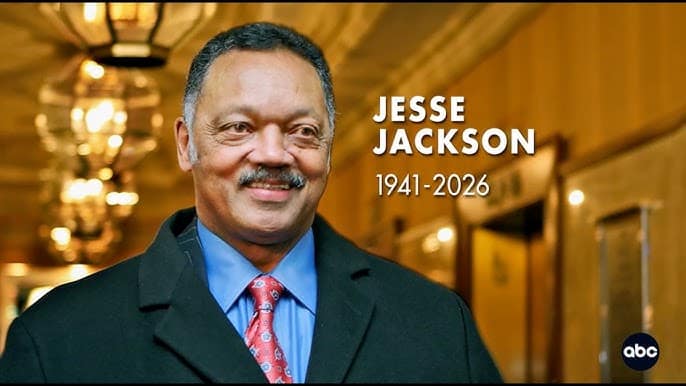



CNN- The Rev. Jesse Louis Jackson, the towering civil rights leader whose moral vision and fiery oratory reshaped the Democratic Party and America, has died, a Rainbow Push Coalition spokesperson confirmed to CNN. He was 84.

Jackson, a protégé of the Rev. Martin Luther King Jr., had been hospitalized in recent months and was under observation for progressive supranuclear palsy (PSP), the Rainbow PUSH Coalition has said.
Jackson was what one pundit called “an American original.” He was born to an unwed teenage mom in Greenville, South Carolina, during the Jim Crow era but rose to become a civil rights icon and a groundbreaking politician who mounted two electrifying runs for the presidency in the 1980s.

Jackson’s dual bids for the Democratic presidential nomination inspired Black America and stunned political observers who marveled at his ability to draw White voters. He was a Black crossover figure long before Barack Obama hit the national stage.

Jackson first rose to national prominence in the 1960s as a close aide to the Rev. Martin Luther King Jr. After King’s assassination in 1968, Jackson became one of the most transformative civil rights leaders in America — to the chagrin of some of King’s aides, who thought he was too brash.
But his Rainbow Coalition, a bold alliance of Blacks, Whites, Latinos, Asian Americans, Native Americans and LGBTQ people, helped pave the way for a more progressive Democratic Party.

“Our flag is red, white and blue, but our nation is a rainbow – red, yellow, brown, Black and White – and we’re all precious in God’s sight,” Jackson once said.
One of Jackson’s signature phrases was “Keep hope alive.” He repeated it so often that some began to parody it, but it never seemed to lose meaning for him. He was a force for social justice over three eras: the Jim Crow period, the civil rights era and the post-civil rights era that culminated with the election of Obama and the Black Lives Matter movement.

Through his eloquence and singular drive, Jackson didn’t just keep hope alive for himself. His dream of a vibrant, multiracial America still inspires millions of Americans today.
Jackson’s vision remade the Democratic Party. He was the first presidential candidate to make support for gay rights a major part of his campaign platform, and he made a concerted effort to challenge the Democratic Party’s prioritization of White, moderate, middle-class voters, says David Masciotra, author of “I Am Somebody: Why Jesse Jackson Matters.”
“A Democratic party that now represents a multicultural America and has someone like Kamala Harris as the (former) Vice President and Obama as the former President began in many ways with those Jackson campaigns,” Masciotra says.
Obama may have never made it to the White House without Jackson’s pioneering presidential runs. Jackson successfully fought to change the awarding of delegates during the Democratic primaries from a winner-take-all system that benefitted frontrunners to a proportional system that helped other candidates even if they didn’t win a state.
Those changes helped Obama mount a come-from-behind victory over frontrunner Hillary Clinton during the 2008 Democratic primaries, Masciotra says.
Jackson was once asked if it hurt that he didn’t become the nation’s first Black president.
“No, it doesn’t,” he told a Guardian columnist, “because I was a trailblazer, I was a pathfinder. I had to deal with doubt and cynicism and fears about a Black person running. There were Black scholars writing papers about why I was wasting my time. Even Blacks said a Black couldn’t win.”
Jackson smashed the perception that a Black person couldn’t be a viable presidential candidate. Some pundits predicted he would be outclassed by his more experienced political opponents during the presidential debates. They grudgingly recognized his charisma, but many never gave him credit for his analytical ability and political savvy.
“It turned out he not only held his own; he often won those debates,” Masciotra says.
The child prodigy who was a double outcast
Political observers shouldn’t have been surprised. Jackson was one of the most gifted communicators in American history. Even as a child, he had a preternatural facility with words and metaphors. Like King, he injected the rhyming, cadences and poetic imagery of Black church preaching into American political life.
“Jesse was an unusual kind of fella, even when he was just learning to talk,” Noah Robinson, Jackson’s father, told The New York Times in 1984. “He would say, ‘I’m going to lead people through the rivers of the water.’’’
Jackson’s signature line, “I Am Somebody,” which he often chanted during speeches, was aimed as much at himself as it was to his audience. Marshall Frady, who wrote “Jesse: The Life and Pilgrimage of Jesse Jackson,” said Jackson was prodigiously gifted but was plagued by “chasmic insecurities despite all he’s done.”
Some of those insecurities sprang from his childhood. Jackson was born on October 8, 1941, in Greenville, South Carolina — a double outcast because of his race and the circumstances of his birth. He was born in the Jim Crow South to Helen Burns, then an unmarried 16-year-old, and her married-next-door neighbor, Noah Robinson. Burns married a year later, and her husband, Charles Jackson, adopted her son.
Biographers invariably describe Jackson as feeling lonely and different as a child. He was teased by classmates for being “a nobody who had no daddy.” Frady described Jackson as an “aggrieved and brooding little boy.”
But Jackson told a New York Times reporter that he had a “father surplus.” He said his biological and adoptive fathers were friends, and that he inherited his strong ego and “sense of dignity” from his biological father.
Advertise with the mоѕt vіѕіtеd nеwѕ ѕіtе іn Antigua!
We offer fully customizable and flexible digital marketing packages.
Contact us at [email protected]




Thanks you for your service Reverend. You’ve fought a good.
HOWEVER, the shooter knew Dr. King would be on the balcony at that specific time. Who told him? Who benefitted as a result of Dr. Kings death!!!
Comments are closed.