






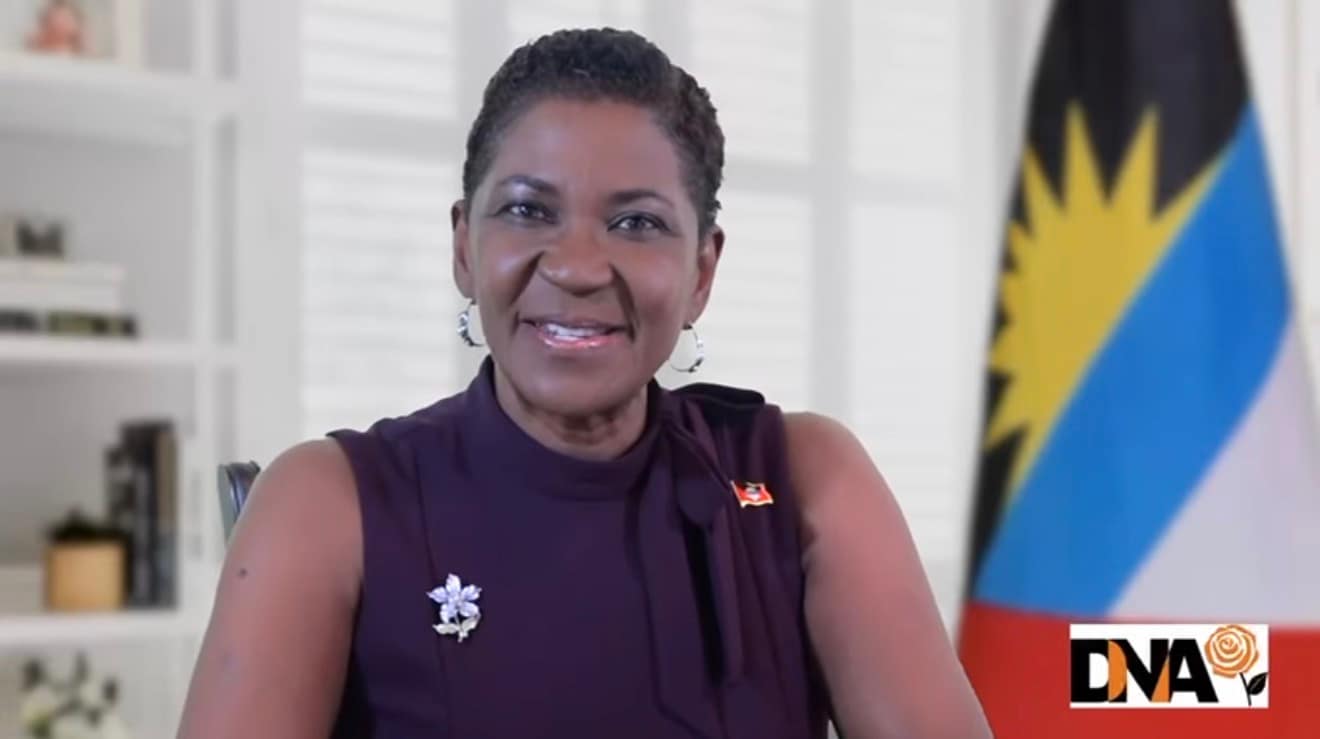



Joanne Massiah, attorney and president of the Democratic National Alliance (DNA), has called for more women to be elected to parliament to ensure female perspectives are reflected in national laws and policies.

She made the comment during a panel discussion at the University of the West Indies Five Islands Campus marking International Women’s Day 2026 under the theme “Give to Gain”.
Massiah was responding to a question from a first-year law student about the continued marital rape exemption in Antigua and Barbuda’s Sexual Offences Act of 1995. The student described the legislation as among the weakest in the region in protecting victims.

“My short answer is that we have to put more women in parliament,” Massiah said, arguing that the country still operates within a patriarchal system influenced by religious traditions that can disadvantage women.

The student, who studies at the University of the West Indies Cave Hill campus, said Caribbean classmates had asked about Antigua and Barbuda’s legal position. She noted that countries including Barbados, Trinidad and Tobago and Dominica have already removed marital rape exemptions.
Attorney Annetta Jackson, a Chevening Scholar and gender policy adviser, agreed the exemption was a serious concern, describing it as rooted in colonial views of marriage and bodily autonomy.

“If as an unmarried person I have the autonomy to choose my partner, the same principle should apply in marriage,” Jackson said. “If boundaries are breached and sex is non-consensual, it should be treated as such.”
Jackson said the continued exemption reflects a colonial legacy that treated marriage as a private sphere beyond the reach of the law, adding that evolving domestic violence jurisprudence shows such views are increasingly being challenged.

Advertise with the mоѕt vіѕіtеd nеwѕ ѕіtе іn Antigua!
We offer fully customizable and flexible digital marketing packages.
Contact us at [email protected]




The call for increased representation of women in Parliament is a critical, ongoing global and regional one designed to shift legislative focus towards issues affecting women, such as gender equality, domestic violence, economic empowerment, and childcare. Research indicates that higher numbers of women in political leadership lead to improved social policies, reduced corruption, and better representation of diverse perspectives, and a strengthening of democracy. Sadly though, the voices of women in our Parliament always seem muted as they often seem to tow the line and just rubberstamp any issue that comes before Parliament whether they be good, bad or indifferent.
call welcomed
More women in parliament!!!!!!
How do you propose that this happens?
I have heard that call several times however I have not heard any suggestions on how we achieve this objective.
Do we want more women in parliament or do we need better representatives in parliament?
I would want to believe that what we need is better representatives.
Parliament is comprised of those elected by the populace.
And according to the choices made we can conclude that wr have the best choices sitting in parliament.
That’s just a conclusion and not always reality.
Our elections have become a popularity contest rather than a competence contest.
Additionally it is the woman who lead the process in selecting and electing the men into parliament.
It is the women who launch the most vicious attack against other women seeking political office.
Pearl Quinn-Williams contested the last general elections against Max Fernandez.
The contest was chalk verses cheese.
Pearl Quinn-Willians was the better candidate in every aspect
Yet, the people chose Max Fernandez.
Why?
Our elections have become transactional.
It is not about what can the represetative do for the constituency and nation.
It is rather about what i can get personally.
It is about which candidate gives more in exchange for the vote.
Hence Fernandez is on the side with the treasury as its campaign piggy bank.
The side who had more to give away.
So he won that elections.
Women have the additional responsibility to align themselves with a party which promotes women.
They have the responsibility to align themselves with the party which is seen to be more scrupulous.
Show me your friend and associates and I will tell you a lot about yourself.
That is so true for the party which has presented only TWO women in its history as a candidates.
Why was the present winner presented?
Her husband is the party leader and he wanted to create a dynasty.
He was willing to give away Antigua to ensure that his wife was elected into parliament.
He degraded other women of his own party to pave the way for his wife to be the labour party female candidate.
How many of us will ever forget the party’s leader famous statement that “the ego of an aspiring candidate was bigger than her competence” because she dared to challenge his wife when a candidate was being sought for that constituency?
Yet once his wife was selected and elected he made the woman with the big ego president of the senate.
The United progressive party has respected the wishes of the constituents and selected as its candidate several women.
It is a UPP candidate who was the first ever female candidate in our parliament.
Another female under the UPP banner became the second.
The ALP has also had two since.
However let us also not forget that Gail Christain committed an unforgiveable sin by becoming pregnant while in the senate.
She was unceremoniously plucked out.
There and then her political life ended.
I continue to ask the question how do we achieve the goal of more women in the parliament.
Is it the expressed opinion of those seeking to achieve that goal of putting female candidate against female candidate?
Or is it their suggestion where a woman is the candidate and the other party cant fill a suitable female that the one female enters parliament unopposed or unchallenged?
That would water down the electoral.process.
Already our parliament doesn’t have the best candidates.
It would worsen the situation.
I stand in solidarity with Dame D Giselle Isaac who said she sees candidate and not sex when elections are called.
She maintains that the females have just as much chance as the males during the elections.
They are not selected because women who lead the campaigns and the selection and elections process defeat those aspiring women before they make their intentions known.
This is one call that will never be realized.
Women will have to work, work harder, work very hard to get a seat in the halls of parliament and not by virtue of their gender.
It’s OK, Miss Massiah. You will be back there very soon. Your party members are busy clearing cassie for you in the UPP. All of them who went back in have quickly acquired positions of influence in the party. Two of them have candidate status. The UPP will not last and they will sort out things so you could join them once more as their leader.
At present the chairman of the UPP is busy purging the party of its original members, even those who are instrumental in the upkeep of the party.
She is like Trump. Not interested in party health, just revenge on all members who do not kiss the ring.
So, Mam, just have patience. You will get it back soon.
Did Joanne recently get knuckled? She’s been posting on her What’s App like a mad- woman about love and relationships.
@Be Patient
kiss what ring? Is the chairman the POPE?
Anyway we all know that ALL MEN IN UPP are scared of her. She has outshone them when it comes to having TESTICULAR FORTITUDE. She is not a pushover and dat bun dem real bad.
As far as Joanne and the UPP are concerned, never the twain shall meet. There is too much bad blood all because of stupidity and pig headedness on both sides
@ Born and Bred Antiguan
Joann could probably Prime Minister by now. She could not wait, that’s what happens when you are Power Hungry. Personally I believe she is also going to end up in ABLP sooner rather than later. Where else is she going to go? DNA is still trying to figure out their own DNA
Comments are closed.