








CLICK HERE TO JOIN OUR WHAT’S APP GROUP

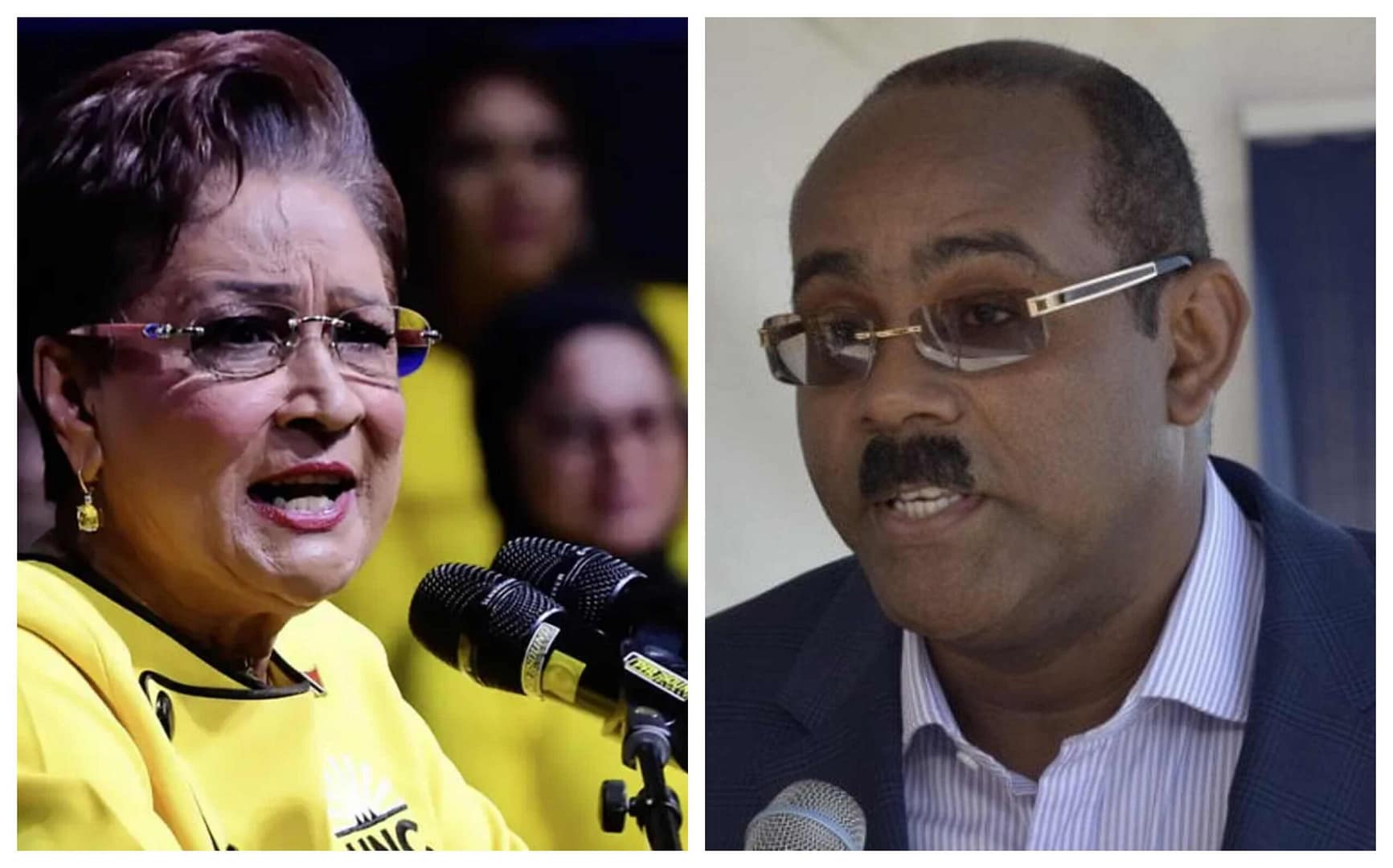
DAREECE POLO SOURCE CNC 3 TV: Antigua and Barbuda Prime Minister Gaston Browne has opened the new year standing firm on his criticism of Prime Minister Kamla Persad-Bissessar, while signalling a willingness to engage in dialogue to ease regional tensions and resolve long-standing financial disputes.
Speaking in a New Year’s Eve interview with state-owned ABS TV, Browne described Persad-Bissessar’s renewed characterisation of Caricom as an “unreliable partner” as “divisive” and “unfortunate”.
However, he said he had no interest in escalating a public feud, framing his response instead as a necessary correction rooted in what he described as historical facts about the benefits Trinidad and Tobago has derived from regional integration.

“They enjoy a trade surplus of over a billion dollars annually. And if that is not a reliable partnership, then I don’t know what is,” Browne said.
Defending the regional bloc, Browne rejected suggestions that he had engaged in hostile rhetoric, saying his intervention was aimed at restoring perspective rather than inflaming tensions.

“So, I have never attacked Kamla. All I did was state, respectfully, what the facts are.
It was not designed to inflame the situation, but to bring some level of clarity and resolution to the rhetoric, with the hope that Kamla will understand the importance of Caricom, turn down her rhetoric, and recognise that, at the end of the day, we are all part of a Caricom family,” Browne said.

He warned that sustained attacks on the regional bloc risk weakening small Caribbean states at a time of increasing geopolitical pressure.
Despite the sharp exchanges, Browne said he expects Persad-Bissessar to attend the 50th regular meeting of the Conference of Heads of Government of Caricom, scheduled for February 24 to 27 in Basseterre, St Kitts and Nevis.
The meeting will see the chairmanship passed from Jamaica’s Prime Minister Andrew Holness to St Kitts and Nevis Prime Minister Dr Terrance Drew, who will lead Caricom from January to June 2026.
Browne said he would seek a bilateral discussion with Persad-Bissessar if she attends, aimed at advancing long-outstanding commitments arising from the collapse of Colonial Life Insurance Company (CLICO) and British American Insurance Company (BAICO).
The financial crisis, which began in late 2008, sent shockwaves across the Caribbean, severely affecting Trinidad and Tobago—home to CLICO—and the Organisation of Eastern Caribbean States (OECS).
The fallout disproportionately impacted the Eastern Caribbean Currency Union (ECCU), where policyholders’ exposure to CLICO and BAICO reached as high as 15 per cent of some countries’ 2009 GDP.
OECS governments were forced to implement costly interventions and bailouts to protect policyholders, placing significant strain on national budgets and sharply increasing public debt.
Browne acknowledged that Persad-Bissessar’s People’s Partnership administration had paid US$40 million of the roughly US$60 million owed, contrasting that with what he described as inaction under People’s National Movement administrations.
He said he was grateful for the partial settlement and expressed hope that the new year would bring progress on a payment mechanism that would provide relief to policyholders without placing undue strain on Trinidad and Tobago’s finances.
Framing the issue as both a moral and regional responsibility, Browne said many affected policyholders continue to suffer more than a decade after the collapse.
Guardian Media contacted Persad-Bissessar, Foreign Affairs Minister Sean Sobers and Caricom Ambassador Ralph Maharaj for comment. Up to the time of publication, there was no response.
CLICK HERE TO JOIN OUR WHAT’S APP GROUP
CLICK HERE TO JOIN OUR WHAT’S APP GROUP
CLICK HERE TO JOIN OUR WHAT’S APP GROUP
CLICK HERE TO JOIN OUR WHAT’S APP GROUP
CLICK HERE TO JOIN OUR WHAT’S APP GROUP
CLICK HERE TO JOIN OUR WHAT’S APP GROUP
CLICK HERE TO JOIN OUR WHAT’S APP GROUP
CLICK HERE TO JOIN OUR WHAT’S APP GROUP
CLICK HERE TO JOIN OUR WHAT’S APP GROUP
CLICK HERE TO JOIN OUR WHAT’S APP GROUP
CLICK HERE TO JOIN OUR WHAT’S APP GROUP
CLICK HERE TO JOIN OUR WHAT’S APP GROUP
Advertise with the mоѕt vіѕіtеd nеwѕ ѕіtе іn Antigua!
We offer fully customizable and flexible digital marketing packages.
Contact us at [email protected]