





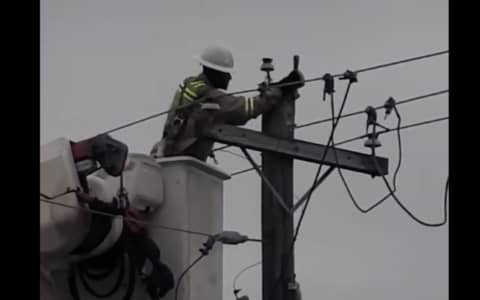



Antigua and Barbuda will begin offering 110-volt electricity to homes and businesses from 2026 in a major overhaul of the national power network, the government has announced.

Utilities Minister Melford Nicholas said the Antigua Public Utilities Authority (APUA) would roll out the option over three to five years, ensuring every consumer who wants 110-volt service can access it. The move follows growing public demand, as more imported appliances are designed for the US market.
“Most homes still operate entirely on 220 volts, forcing people to rely on step-down transformers,” Mr Nicholas said. “We want to move away from that and make 110-volt power readily available.”

He cautioned that some properties may need internal electrical upgrades and warned that heavy reliance on transformers increases costs and fire risks, particularly in older wooden houses.

APUA Electricity Business Manager Andre Matthias said the country’s 220-volt system reflects its British colonial legacy. With most appliances now designed for 110 volts, he said offering the alternative is “simply practical”.
APUA is considering a consumer advisory team to guide households through the transition, though it will not carry out installations. The government has described the initiative as part of a wider push to modernise the nation’s energy infrastructure.

Advertise with the mоѕt vіѕіtеd nеwѕ ѕіtе іn Antigua!
We offer fully customizable and flexible digital marketing packages.
Contact us at [email protected]




Please roll out pay as you go electricity home meters.
Now that is what I call making Dollars and sense (cents)
Hmmmmm the amount of commitments and promises I hear already I will just wait till it happens
This makes sense. Absolutely.
I know that this might be excellent news for most citizens because most of our household appliances and tools comes from the US. However, there are actually advantages and disadvantages of 120 volts versus 220 volts. Let’s first look at 220 V…..
If we look closely, most electrical kettles, air conditioning units, clothes dryers and water heaters are 220 V. You can actually bring water to boil quicker with 220V because 120V do not supply as much power per ampere as the 220V. This can result in lower electrical bills than if it was 120V.
Now for 120V; 120V presents a lower shock risk but it cannot supply as much power per ampere as 220V. Therefore large loads of 120V circuits around the house pulls more amperes and one might see an excessive rise in electricity bills.
It is wise to consult your electrician in order to get a better understanding of one versus the other.
If managed well, it’s a long-term win — but rollout must be transparent and affordable.
@Audley: Your response above is both confusing and misleading. The good thing is that you suggest consultation with an electrician. To state that 120V does not supply as much power per ampere a the 220V is quite true but based on the very foundation of power, it does not make sense to use that as a basis. The formula for power is voltage times current (ampere) and hence if you want a power of 1200W, it would naturally mean that if you up the voltage, you must lower the current (ampere) to keep the power constant.
Instead, it would be better to note that since 120V will necessitate a larger current flow to meet the same power, you need to ensure that your wiring is done with the appropriate size conductors.
As it relates to the shock risk, I believe it would have helped if you noted that the main danger to our body is the current (ampere) rather than the voltage. A high voltage is actually used to revive the heart. Using correct fuses with 220v since it requires smaller current flow would be helpful.
It should also be stated that even if you have 110 at your house, you could still get 220V for items that require than voltage.
However, many homes presently either uses a big transformer to convert their home to 110/120V or uses several small transformers for various equipment. The transformers themselves consumes power (usually you will feel them getting warm) and that is also a cost.
Great work APUA, this will reduce the amount of VARS that the power generation plant sees which are just costing the consumers and technical lost. And don’t be confused, it means split phase 120/240 so you will still have both voltages, the consumer savings will be that transformer you have to purchase for appliances around the house is zero cost and reduce electricity bill because of loses powering that transformer.
Zohran wants open streets to stay. — New York City
Comments are closed.