









New Insect‑Proof Net Technology Shows Promise for Pesticide‑Free Vegetable Farming in Antigua and Barbuda
St. John’s, Antigua — January 2026 By: Tyreke Thomas-Horsford.

A new, environmentally friendly method of growing vegetables without pesticides is showing strong promise in Antigua and Barbuda, following a successful field demonstration carried out under an agricultural cooperation programme between Antigua and Barbuda and the People’s Republic of China.
The trial, conducted in collaboration with the Crop Research & Development Division (CR&D) within the Ministry of Agriculture, utilised insect‑proof nets to protect vegetables from destructive pests — without relying on chemical pesticides.
According to the project experts, the results indicate a major opportunity to improve local food safety, reduce production costs, and support more sustainable farming practices across the country.

A Simple Idea with Big Results
The technology, officially known as Light and Simplified Green Prevention and Control Technology for Plant Pests, relies on a straightforward principle: if insects are physically blocked from infesting crops, there is no need to kill them with chemicals.

Instead of spraying pesticides, farmers can utilize fine‑mesh insect‑proof nets to cover planting areas. These nets allow sunlight, air and rain to pass through but prevent common pests such as aphids, thrips, flea beetles, and diamondback moths from infesting the plants.
“This method focuses on prevention rather than treatment,” explained Dr. Lu Jiaju, Associate Researcher at the Institute of Subtropical Crops, Guizhou Academy of Agricultural Sciences, and lead technical instructor on the project. “If insects cannot reach the vegetables, they cannot damage them or spread diseases.”

Field Trial on Chinese Cabbage
The trial focused on Chinese cabbage, a popular leafy vegetable that is highly vulnerable to insect damage in tropical conditions.
Preparation began in early November 2025, with the field thoroughly cleaned to remove plant residues and weeds that could harbour pests. The soil was then solarized — covered with plastic and exposed to sunlight — to kill insect eggs and harmful organisms in the soil.

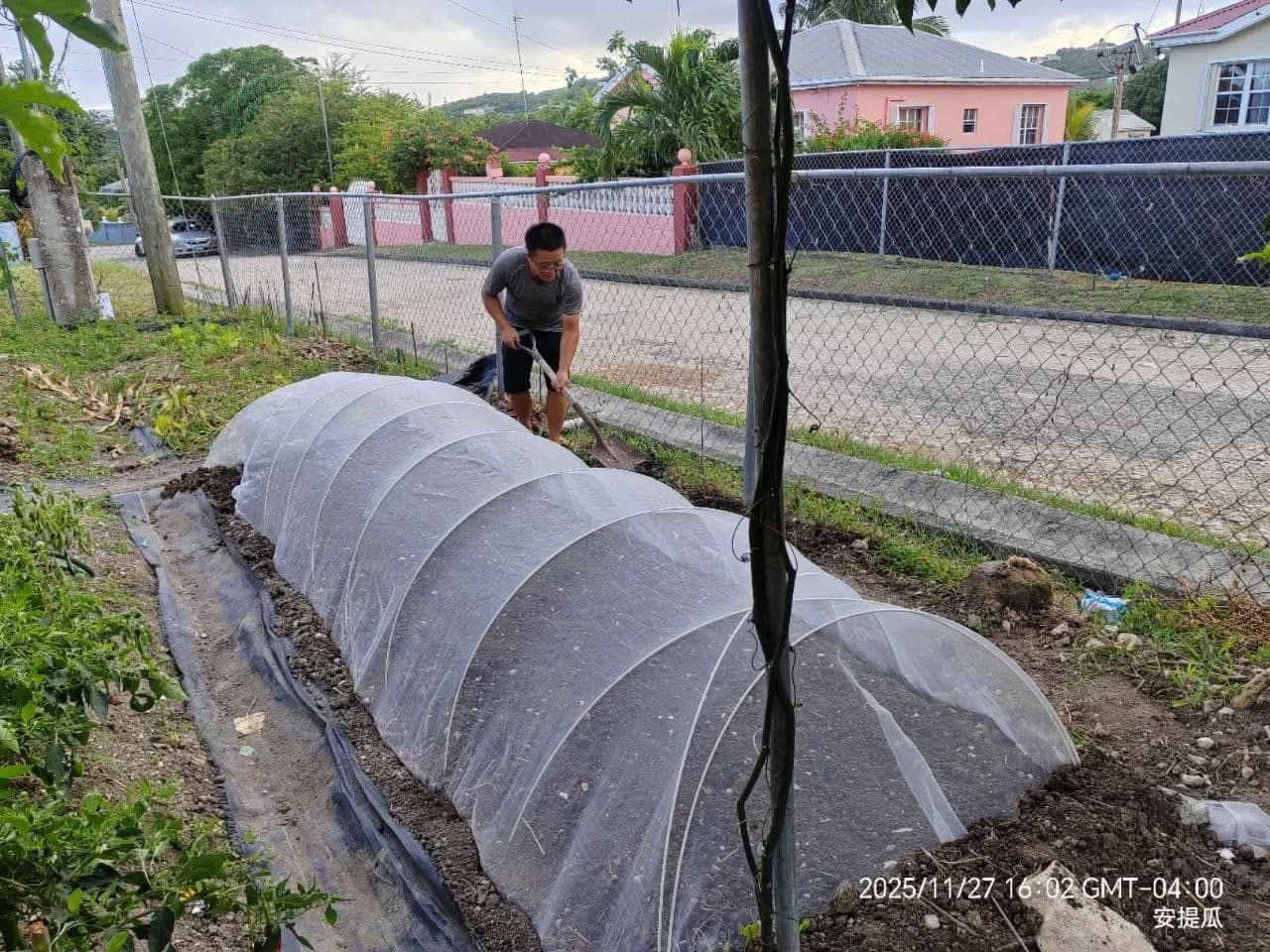
After this process, an arched greenhouse structure covered with insect‑proof netting was constructed. The netting was sealed in a way that allowed insects emerging from the soil to exit but prevented new pests from entering once planting began.
On November 27, cabbage seeds were sown and immediately covered with the insect‑proof nets. A nearby control plot was planted without nets and any application of pesticides, to allow for comparison.
Clear Difference at Harvest
When the first harvest took place on January 3, 2026, the contrast between the two plots were striking.
Cabbage grown under insect‑proof nets was healthy, uniform, and completely free from pest damage — achieved without any pesticide application. In comparison, the open‑field cabbage was almost entirely destroyed by insects.
Officers from the Crop Research & Development Division who observed the trial at harvest confirmed the results, noting the potential impact this method could have if adopted more widely.
Safer Food, Higher Quality
Beyond preventing crop loss, the technology also improves vegetable quality. When plants are attacked by insects or exposed to pesticides, they often produce bitter compounds as a stress response. Vegetables grown under insect‑proof nets avoid this stress, resulting in better taste, texture, and appearance.
“Consumers want clean, safe food,” said one agricultural officer involved in the trial. “This technology help farmers meet that demand while protecting the environment.”
Broader Potential for Local Agriculture
While the trial focused on cabbage, the insect‑proof net technology can also be used for other crops commonly grown in Antigua and Barbuda, including tomatoes, cucumbers, eggplants, watermelons, broccoli, napa cabbage, and cowpeas.
The Ministry of Agriculture, through the CR&D Division, plans to continue evaluating the technology on additional crops and expand demonstration plots, including at the Bethesda agricultural base.
Looking Ahead
As part of the next phase of the agricultural assistance project, organizers plan to conduct training sessions for farmers, promote hands‑on demonstrations, and encourage gradual adoption of the technology.
Although the initial investment in net structures is higher than traditional open‑field farming, experts emphasize that savings from reduced pesticide use and higher market prices for cleaner produce can quickly offset the costs.
“This is a long‑term investment in our food system,” Dr. Lu said. “By working together with the Ministry of Agriculture, we can help farmers produce healthier vegetables and strengthen food security in Antigua and Barbuda.”
Advertise with the mоѕt vіѕіtеd nеwѕ ѕіtе іn Antigua!
We offer fully customizable and flexible digital marketing packages.
Contact us at [email protected]



Once again the Chines coming to our support in agriculture. Will our farmers adapt this technique? Or will the continue to do the same thing. Because as far as they are concerned they have been farming this way for decades and cannot or will not change. I won’t hold my breath. But if I’m the minister I consider any farmer over a certain age un-teachable and move on with the youth.
if some local farmer came to yall and brought this idea, yall kno wat yall would do…..but it took china to convince them to go shouls and order some baby crib supplies in bulk to put in a garden. but then they say ohhh antigua nuh have professionals or antigua nuh have ppl with background this and that….but a chinese can come and say hey…lets use that shit on a babys crib so we dont have to worry about pests and yall said yayyy like the black sellouts u are….a local man cud said this shit and u all wud call him crazy, this is bullshit…good idea ….hands down great idea……action behind it utter bullshit and gassy dread in act again….(note well, gassy dread is a rebrand to avoid public scrutiny under tha real alias he carries so he can be as open as he wishes,) someone listen a few youtube videos about marcus aurelius and thinkis he is the new caesar…lol gassy, i cud do a better job than u i swear!!)
While a good idea, every farmer knows that these cannot be used to grow cucumbers, watermelons, or any crop that relies on insects for pollination.
Comments are closed.