






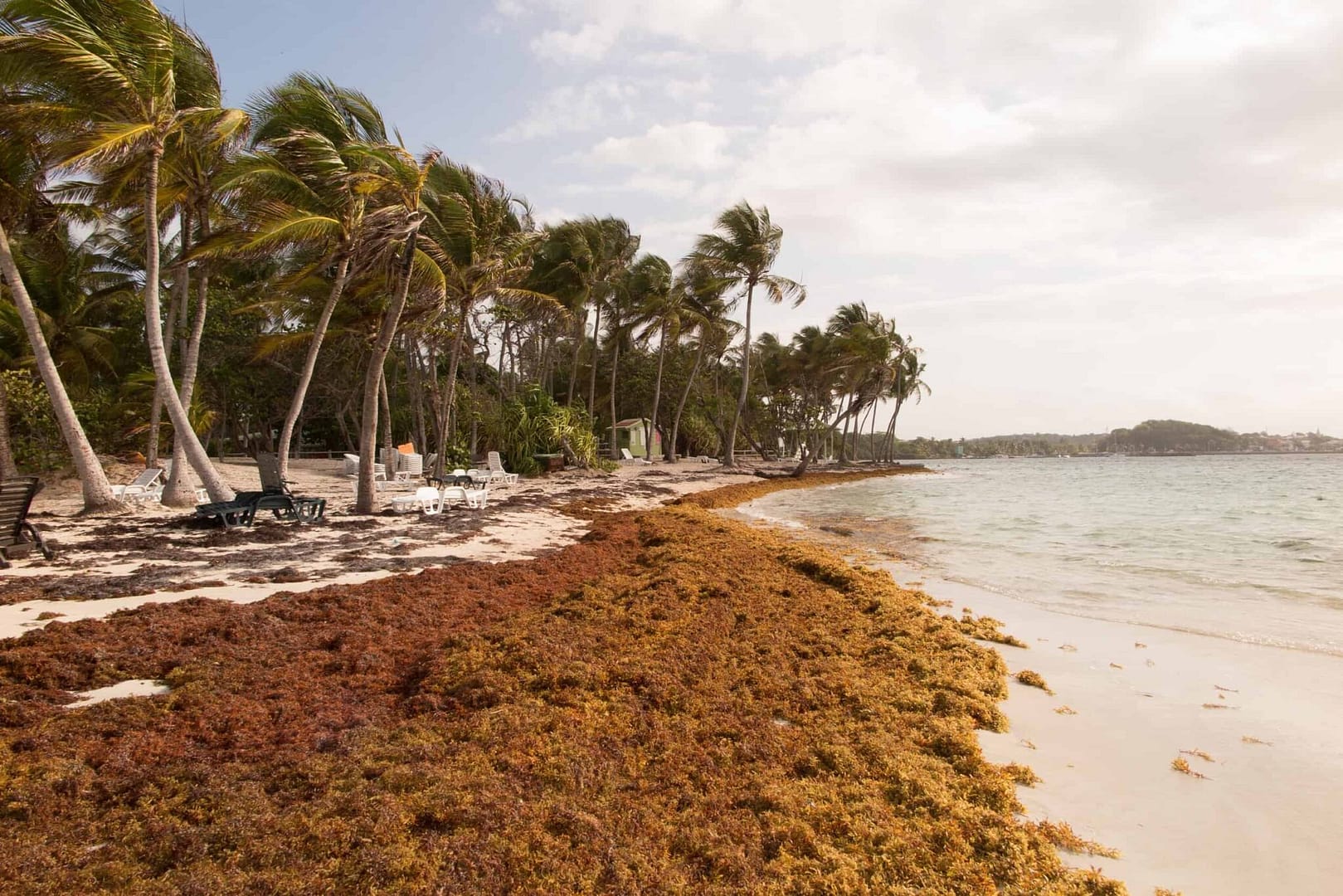



Caribbean islands, including Antigua and Barbuda, are being advised to prepare for a gradual rise in sargassum activity during the first quarter of 2026, according to a regional outlook from climatologist Dale C. S. Destin.

Satellite imagery shows increasing sargassum concentrations in the Central Atlantic, a development that often signals heightened arrivals in the Caribbean. While extreme events are not expected early in the year, conditions are forecast to worsen steadily, particularly from late March.
For Antigua and Barbuda and other northern islands, mild sargassum influxes are expected in January, with conditions likely intensifying to moderate levels during February and March. Mr Destin warned that 2026 could prove more challenging than last year, as ocean currents and prevailing winds favour earlier and more sustained arrivals.

Antigua experienced several episodes of sargassum accumulation in 2025, mainly along eastern and northeastern coastlines, affecting beaches, nearshore waters and small fishing operations. Similar pressures are anticipated this year, with the risk of longer-lasting build-ups if early monitoring and mitigation are not implemented.

Further south, islands including Martinique, St Lucia, St Vincent and Barbados are expected to see mostly mild conditions until late March, when heavier influxes become more likely. The southern Caribbean, including Grenada, Tobago and Trinidad, is forecast to experience limited impacts during the early months.
The outlook is based on the Sargassum Sub-regional Outlook Bulletin from the Centre for Resource Management and Environmental Studies at The University of the West Indies, Cave Hill Campus. The next update is due in early April 2026.

Advertise with the mоѕt vіѕіtеd nеwѕ ѕіtе іn Antigua!
We offer fully customizable and flexible digital marketing packages.
Contact us at [email protected]




Sargassum has being adversely impacting our tourism industry.
From the burdensome costs of maintaining our beaches across the entire Caribbean to those who do not return as a result of a bad experience.
Given the adverse impact on tourism, our main source of Foriegn currency.
What does The Centre for Resource Management and Environmental Studies at The University of the West Indies, Cave Hill Campus do except issuing bulletins.
I’m aware of Legena Henry, a mechanical engineer and renewable energy lecturer who heads the Rum and Sargassum biofuel project in Barbados; as well our own Rosa B. Nelson a biology student at Hofstra University who was selected as the 2026 Rhodes Scholar conducting research on how sargassum may be converted into a biofuel.
Is this another example of UWI and its lectures issuing papers that no one else but their colleagues read?
When are the PONTIFICATING POLITICIANS and the RHETORICAL ACADEMICS across The Caribbean begin to apply solutions readily available, to create a prosperous Caribbean?
Is how long we hearing they making gas out of that .
Comments are closed.