









Brett McGurk is a CNN global affairs analyst who served in senior national security positions under Presidents George W. Bush, Barack Obama, Donald Trump and Joe Biden.
CNN- More than two decades ago, on January 24, 2004, I landed in Baghdad as a legal adviser, assigned an office in what was then known as the Green Zone. It was raining and cold, and my duffle bag was thrown into a puddle off the C-130 aircraft that had just done a corkscrew dive to reach the runway without risk of ground fire. Young American soldiers greeted me as we piled into a vehicle, sped out of the airport complex and then along a road called the “Highway of Death” due to car bombs and snipers.
What has our country gotten itself into?
That was my first thought on that harrowing ride, and over the course of a year in the country and then across subsequent presidential administrations, I often counseled prudence and caution when setting American foreign policy objectives. That is especially the case when it comes to the use of military power, the application of which must be tied to clear, articulated and achievable aims.
You might think the current situation in Venezuela – where the US has now deployed 15% of its naval power and is conducting ground exercises nearby – triggers a cautionary tale to stop before our country once again finds itself in a situation that we do not fully understand with uncertain consequences.
Not so fast.
The situation in Venezuela today has little comparison to Iraq and far more resembles Panama 35 years ago, before the US military operation to remove a dictator and install an elected government that enjoyed vast support from the population there. That mission was a success, and Panama today is a functioning democracy, friendly to the US, albeit not without problems from crime to corruption.
Is it possible that we are so paralyzed by the Iraq (and Afghanistan) experience, to miss an opportunity to improve the lives of Venezuelans and stability in our own hemisphere along the lines of Panama?
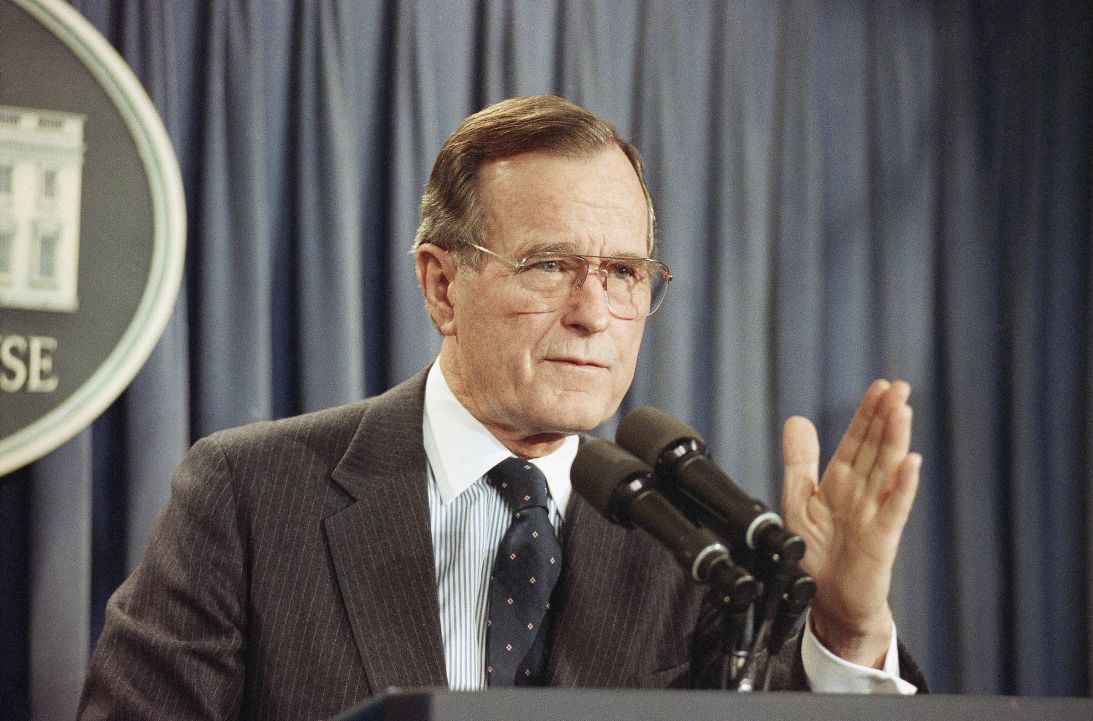
US President George H.W. Bush answering a question during a press conference on December 22, 1989. Bush said he won’t be satisfied until Panama’s Manuel Antonio Noriega is brought to justice and that the United States will hunt him “as long as it takes.” Ron Edmonds/AP
Venezuela and Panama: Similar Pretexts
On December 20, 1989, President George H.W. Bush addressed the nation to define the rationale behind the mission he had just ordered into Panama. He explained that Panama was led by “an indicted drug trafficker,” Manuel Noriega, who would soon “be brought to justice” in the US. Bush added that Noriega annulled democratic elections, and that the winners of those elections would soon take power in Panama City likely with broad support. Noriega’s regime also threatened and harmed Americans, including the recent death of an American soldier, shot by Noriega’s security services.
Finally, Bush discussed the strategic importance of the Panama Canal, and Washington’s commitment to existing treaties that Noriega was unlikely to honor.
Against that backdrop, Bush explained the goals of the mission: “To safeguard the lives of Americans, to defend democracy in Panama, to combat drug trafficking, and to protect the integrity of the Panama Canal Treaty.”
Two weeks later, Noriega was in US custody, the elected opposition government took power, and US forces began to leave the country.
I recently spoke with a former US military counterpart who took part in this operation, parachuting into Panama before Bush made that address. “Out of our many military ventures since Korea,” he told me, “Panama must be considered one of our most successful. To go there now is to see a very prosperous Democratic country.”

US soldiers move a large crane into the area near the Vatican Embassy to Panama, on December 30, 1989. Corinne Dufka/Reuters
Now, let’s look at Venezuela –
The country is run by Nicolas Maduro, who like Noriega faces criminal indictments in US courts. The charges against Maduro are more extensive. His 2020 indictment in New York lists counts of narco-terrorism, drug trafficking, and corruption. He is also accused of heading the trafficking organization “Cartel de los Soles,” which the State Department just branded a Foreign Terrorist Organization. Washington has offered a $50 million reward for anyone that can help bring Maduro into US custody.
Like Noriega, Maduro has also invalidated successive elections and violently suppressed democratic movements inside his country. The US and most of its Western allies recognize the opposition led by Maria Corina Machado as Venezuela’s legitimate government. Opposition parties according to independent observers received 70% of the national vote in Venezuela’s presidential elections in 2024, which Maduro claims to have won.
Finally, Maduro, like Noriega, has threatened and harmed American citizens, as well as regional peace and security. In recent years, like his allies in Iran, Maduro has effectively held Americans as hostages for diplomatic maneuvering with the US. These hostages include an American sailor vacationing in Venezuela, longtime American residents of the country, and US-based executives of Citgo, the US subsidiary of Venezuela’s state oil company.
In 2023, Maduro threatened to invade neighboring Guyana, an American ally, and today claims sovereignty over two-thirds of Guyana, justifying the claim – much like Putin over eastern Ukraine – based on false history and a staged referendum.
Significant differences
If Maduro is replaced in Caracas, there is no guarantee that local authorities throughout the country would work with the new government, opening the prospect for civil wars and a violent competition for power and resources. Maduro claims to have recruited a militia in the millions to resist any US-backed operation, and while that claim may be exaggerated, we should presume that drug cartels may seize control in the countryside as opposed to the forces of democracy we might hope or wish to see prevail.
Venezuela is over 10 times larger than Panama, something military planners would likely recommend required a far larger force than the nearly 26,000 personnel deployed in in the 1989 operation.
The geostrategic context is also vastly different. In 1989, the Soviet Union had collapsed with the Berlin Wall coming down six weeks before the US invasion of Panama. America was the undisputed great power in the world, and there was no reason to expect or anticipate other great powers resisting the military operation or making moves of their own in other hemispheres.
Today, Russia and China are aligned with Maduro, and their leaders would likely cite any US operation in Venezuela as further justification to pursue their own hemispheric ambitions, against Ukraine and Taiwan, respectively.
What are Trump’s options?
President Donald Trump last week said cryptically that he had “made up his mind” on a course of action in Venezuela. That followed CNN reporting on multiple high level White House meetings with military commanders on options following the Naval buildup off the coast and exercises conducted by the US Marine Corps across rural and urban areas of Trinidad and Tobago.
Maduro seems to be reading into these moves a possible American intervention, calling up his militias while also appealing for dialogue, even singing John Lennon’s peace anthem “Imagine” at a recent rally.

People watch the USS Gravely, a US Navy warship, departing the Port of Spain on October 30. The US warship arrived in Trinidad and Tobago on October 26, 2025, for joint exercises near the coast of Venezuela. Martin Bernetti/AFP/Getty Images
Adding to the confusion, the administration has not been clear on the aims for what it now calls Operation Southern Spear. The Secretary of Defense, Pete Hegseth, described the mission as one to “defend our homeland, remove narcoterrorism from our hemisphere, and secure our homeland from the drugs that are killing our people.” While there has been no mention in official statements of restoring democracy in Venezuela, or an objective to seek the removal of Maduro as its leader, Trump has declared Maduro’s days “numbered” and the military deployments, including the most advanced carrier strike group in the US arsenal, suggest aims beyond the publicly stated goals of Southern Spear.

U.S. aircraft carrier arrives near Latin America amid Venezuela tensions
2:56
To be sure, the removal of Maduro is in the interests of the US and the people of Venezuela. Before the rule of Maduro and his predecessor, Hugo Chavez, the country was among the most prosperous in South America, whereas today it’s a shambles with per capita income falling by 72 percent, one of the sharpest economic collapses in history. More than three-quarters of the country by reputable polling opposes his rule, and there is an opposition government prepared to take power if given the chance to do so.
The Trump administration despite its saber rattling seems unlikely to pursue regime change militarily, a course of action that would cut against its stated aversion to prolonged military engagements. Nor would I advise them otherwise. The differences with Panama at this stage outweigh the similarities or hope that an operation against Maduro might go as well as Panama over three decades ago.
But the administration should not withdraw the leverage that it has now built up against Maduro and use it to good effect.

Members of the Bolivarian Militia participate in civic-military training, amid rising tensions with the US in Caracas, Venezuela November 15. Maxwell Briceno/Reuters
Short of a military operation to oust Maduro, the administration can demand that he give up key figures of the drug trafficking networks inside Venezuela, withdraw claims on Guyana, and pledge to hold new elections with international observers, which he would surely lose. To go a step further, the administration might demand his exile, perhaps to Russia, where he can join Bashar al-Asad, the former president of Syria, another dictator who destroyed his own country for the sake of personal power. For any of this to work, the administration would need to secure support from allies, including in South America, something that to date it has been unable or unwilling to do when it comes to its aims in Venezuela.
In any case, before the US embarks on a policy to replace Maduro, whether by military means or otherwise, there should be a congressional debate to weigh pros and cons, something that today also is not happening due to dysfunction in Washington.
Conclusion
The US after two decades of protracted military engagements overseas is rightly wary of any new endeavor that envisions regime change. That caution is warranted, but in Venezuela the case for Maduro’s removal from power are both compelling and draw more parallels to Panama than to Iraq. However, the build-up of military power off its coast can best be used to achieve objectives that in the end do not require its use in the country.
Advertise with the mоѕt vіѕіtеd nеwѕ ѕіtе іn Antigua!
We offer fully customizable and flexible digital marketing packages.
Contact us at [email protected]


Well no it’s not historical parallel to Panama for key reason like the article outlined the size, America had existing base in Panama which was miles away from the official’s building and most importantly the evidence was there supporting the claims against Noriega by testimony by multiple people links which showed him being linked to a leader of a cartel where Maduro’s case there is non, even though they convicted him there is no public evidence just because they use the same playbook doesn’t mean it’s the same.
Venezuela has already has a militia which they claim to be millions they have no land access if Guyana stays out and based of the relationship with Colombia I don’t really expect them to provide access so they would leave sea and air. Russia already has support and China with material support.
The article even outlined the invasion can cause a power vacuum leaving instability on the continent which would cause asylum seekers leaving the country at a higher rate.
In all it’s way more simular to Iraq for the reason the lack of evidence supporting which are their claims for the invasion, it being a resource rich region which they have already made a deal for the oil even before the strikes and the outcome will likely be similar to the vacuums it created in the middle east.
CNN advocating for war…what else is new
YAC….Go buy ur popcorn and take a seat…..Watch the man who sends people to jail for just speaking out against him get thrown out of power….You will see the man who has helped to destroy the Venezuelan economy get thrown out of power……You will see the man who tells the Venezuelan coast guard to look away from the drug traffic get thrown out of power…..No matter all u ramble on and on about because u are a so called Communist and u are heavily against western democratic way…Maybe u should go help Putin fight in Ukraine or whenever Xi Jinping decides to invade Taiwan u can go help fight for Communism…SMH…
@young Communist.
Bro, are you really that naive?
You can hate the US and still understand that Maduro is a cruel leader.
Both can be true. Your rational is way way off.
You can keep spitting your hate for the US, but don’t sit there and use that hate to justify that this mad man from Venezuela is some great leader of his people.
This is the same man who just jailed an opposition for 30yrs for speaking against his regime.
What more evidence you need, along with the others that are mentioned?
Stop talking just to sound educated dude, please.
Blind emotions gets nothing positive done, and the people of Venezuela have voted this same Maduro out of office, and he refused to leave. That’s the system that the Americans are trying to topple, like it or not.
For the people of Venezuela!!!
Panama had no great military buildup. Iraq did. In fact the Iraq invasion had some UN approval since the case was made in the Security Council that Iraq had weapons of mass destruction. And we now know what a big lie that was. What was the case in Iraq that is similar to Venezuela is that it was a country loaded with oil. But then again we all know that Venezuela has the largest oil deposits in the world. And Oil is all what determines the world powers. Who controls it? America is trying to sell the war to their own people. Who frankly speaking do not give a damn. The Iraq war and the Afghanistan war only became a problem for them when too many American soldiers died year in year out. They are making calculations how many American lives this will cost. Not Venezuelan lives. America has never reported how many Iraqis or Afghans were killed in the war they have started. But they reported every American that died. And when the bodies coming home started to increase the people finally started to take note. But before the war they were not interested. It neither here not there to them. Even today in Gaza they never report on the dead of the Palestinians. Only Al Jazeera news media will report that. So as they are making their calculations on the casualties and the War Lords are selling this to Trump who wants to earn the Nobel Peace Price I think the War Lords are working overnight to get their goal implemented. Sad. very Sad. Human life have no value in their eyes. I said before in another post. in the seventies I was happy to be living in Uncle Sam’s backyard. Because I know we were protected. But these days it is Uncle Sam I’m afraid of. Uncle Sam is out of control. And all because Uncle Sam is loosing it’s grip on World Domination slowly but surely. Countries are coming together to undermine Uncle Sam. BRICS. And Venezuelan Oil is what will restore that power. Who Controls the OIL.
@Islanman26 All my “US hate” has been me describing what America has done in past and present.
The reason for his invasion is because they claim he’s a drug lord not because he committed election fraud very different things and I don’t believe they could invade on that cause since it never been used to justify a invasion just gain public support, the article about his government jailing the doctor for being a doctor for 30 years lack so much info personally I can’t make any conclusion off it since there is nothing much but a guy was jail for treason what’s the message no idea what’s the evidence nothing provided, like I can’t really come to a opinion of it being just or not off something like that to even talk about in any light.
The evidence I would like to see is the “drugs boats” being blown up is the being boarded and packages documented, prove the traces back to Maduro, and other ties which would support him being a “narcoterrorist” like testimonies for multiple people. Basically the same paperwork they have for the election fraud like the tally mismatch, official tally not being released on some levels and observers disputing the official claims.
It’s not really blind emotion to be anti-war. What do you expect the outcome of the invasion to be and how bombing the country will be for the people?
@The World, I’m good I rather not support a war in the region especially when Antigua don’t even grow it’s own food so even the simple fact of wars disrupt regions supplies isn’t a good thought to have that certain things might scarce. Also Putin isn’t Communist he’s literally the opposite being a liberal and hates communism and the USSR even if he was I do not support the invasion of Ukraine or if China use military force against Taiwan even through I know the history of the Chinese civil war between the Mao’s CCP and KMT which is now Taiwan was pushed to the island from the mainland the KMT party have flip and actually become support unification by more diplomatic means which is what I personally rather with pro-unification being around 30-40% with keeping the current status quote being the majority opinion.
@young Communist.
I do not condone the killings of anyone, and that is where you and I agree on one thing, but this is a necessity to get rid of this Man, must.
All the things you said can be true, yes yes yes, but I believe in necessary evils, and this one of them. This man must be removed.
The build up is just a show of strength, but I don’t think any war is needed to get rid of Maduro, and it will not come to that.
A dictator is not an elected person. Maduro is an elected president of Venezuela. If the opposition feels and believes he cheated well have your game plan ready for next election. And again I refer to the CARICOM Observers that were there. To include our very own ABEC members. And their report was that the elections were free and fair. I have indicated the complaints of the UPP against the win of the ABLP in last election. Are they holding up in a court? A countries internal affairs is not for anyone else to interfere in. The UN Human Rights Commission will investigate any human rights violations if their are any brought to their attention. America is presently guilty of many violations of human rights. In so much that court rulings are ignored and people are just taken of the street without due process and shipped to prisons in Ecuador and elsewhere. Never to see their loved ones and never be given a fair trial. And what is their crime? Being in the USA illegally. Illegal Aliens should be send back to their country. Venezuela is one of the only countries that has opted to take back any Venezuelan arrested and deported back to their homeland, rather then to have them in a prison camp in Ecuador. The Americans also still operate a prison camp on Guantanamo Bay Cuba. They are holding allege terrorist there now for decades without a trial. The entire world has condemned this practice, but of course they are above any International Law. That is why they can decide who lives and who dies. Who can eat and who will starve to death. That is the way of the world today. One Country sets the rule for all to follow. When will this end? Only God knows.
Comments are closed.