






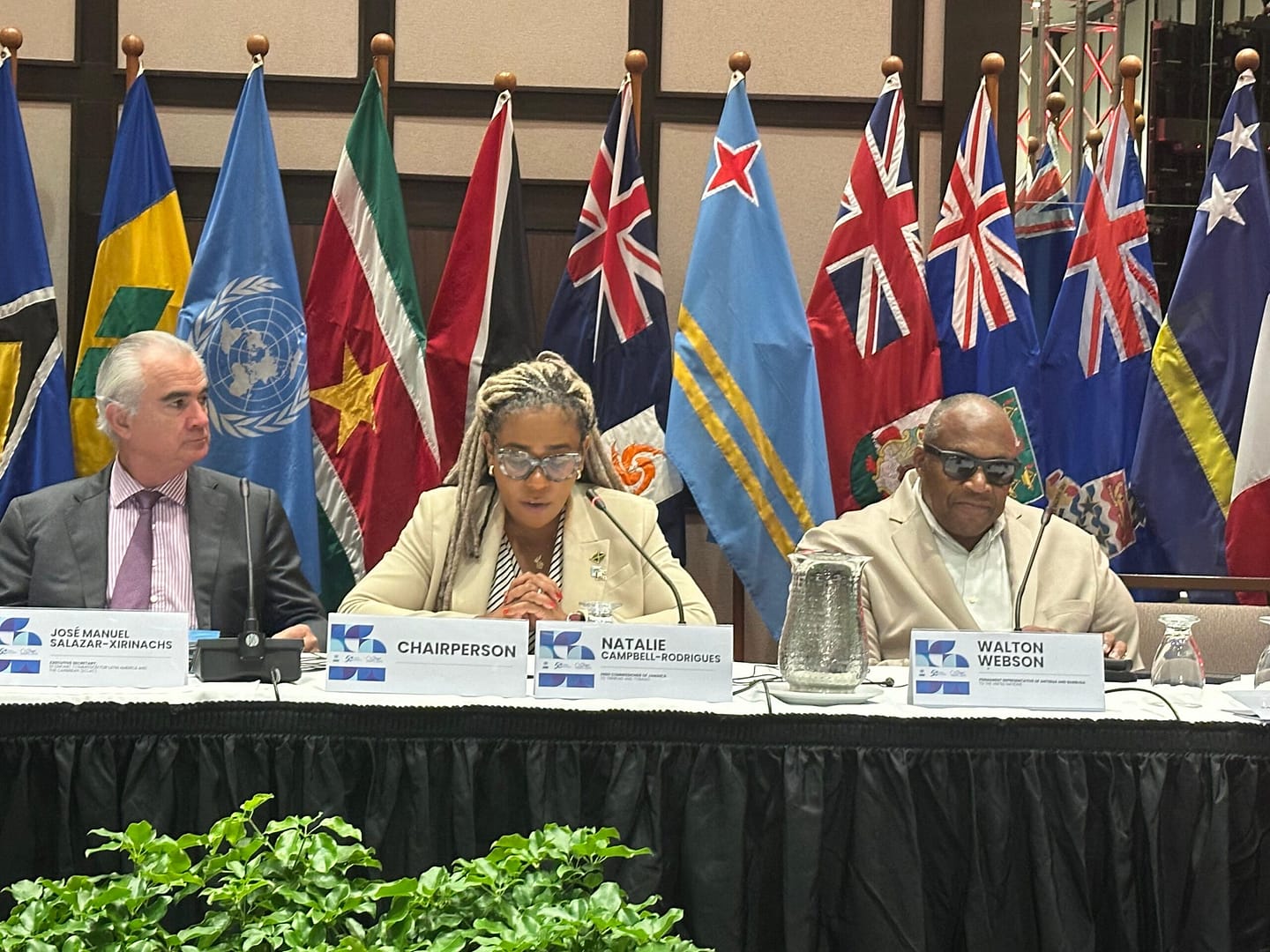


Antigua and Barbuda’s Permanent Representative to the United Nations Ambassador Walton Webson placed the future of Small Island States (SIDS) at the very centre of high level discussions at the recent 22nd Meeting of the Monitoring Committee of the Caribbean Development and Cooperation Committee (CDCC), held in Trinidad and Tobago.

The meeting, which took place on Dec. 8 and 9, was held under the theme “Unlocking Caribbean Potential: Enhancing Growth and Development through South–South Cooperation.” Also joining Ambassador Webson in representing Antigua and Barbuda at the meeting was First Secretary at the Antigua and Barbuda Mission in New York, Claxton Duberry.
Ambassador Webson, made use of the opportunity to serve as a member of a distinguished panel on “Financing for Development: Increasing Caribbean Access to Climate Finance and Innovative Financing Mechanisms,” to articulate a vision of urgency and hope for the future of the Caribbean.

In a stirring intervention, he told a captive audience that the region has arrived at “a turning point that will define the next decade of resilience and prosperity’ for the region. Drawing on the transformative vision of the Antigua and Barbuda Agenda for SIDS – ABAS 2024–2034, Ambassador Webson urged his fellow delegates to recognize that the historic document is a turning point for the region, what he called “a generational decision and a promise” to secure a sustainable, prosperous future for island communities across the Caribbean and for all SIDS.

He stressed that Caribbean Small Island Developing States (SIDS) continue to be trapped within a global financial architecture that penalizes vulnerability and rewards metrics that overlook climate risk. With over 40% of SIDS in or nearing debt distress, Ambassador Webson highlighted the urgent need for new financing rules, better tools, and a regional shift from recovery to resilience.
Against this background, he highlighted the critical role of the new SIDS Centre of Excellence, describing it as a bold initiative that will make use of modern and innovative tools in charting new pathways to resilient development.

As part of Ambassador Webson’s intervention, he outlined the various ground breaking measures being pursued to correct course on the future for SIDS. He cited the operationalization of the Debt Sustainability Support Service (DSSS) as a central tool in this effort as well as working on streamlining and increasing the efficiency in accessing climate finance.
Other key highlights of his intervention include the scaling of debt-for-climate swaps and the introduction of structured resilience bond and domestic currency financing options. He also proposed the expansion of regional mechanisms to include shock-responsive social protection systems, new disaster insurance products, resilience reserves, and drought/heat-response frameworks.

“The Caribbean does not lack investment opportunity — it lacks risk alignment,” Ambassador Webson affirmed, urging action from international financial institutions and calling for public, concessional, and private capital partnerships that align financing with climate realities.
Advertise with the mоѕt vіѕіtеd nеwѕ ѕіtе іn Antigua!
We offer fully customizable and flexible digital marketing packages.
Contact us at [email protected]



I admire mr Webson. He is motivation that your disabilities should not limit your abilities
The real test will be whether these meetings change how funds are accessed, not just how often we’re invited to speak.
Comments are closed.