






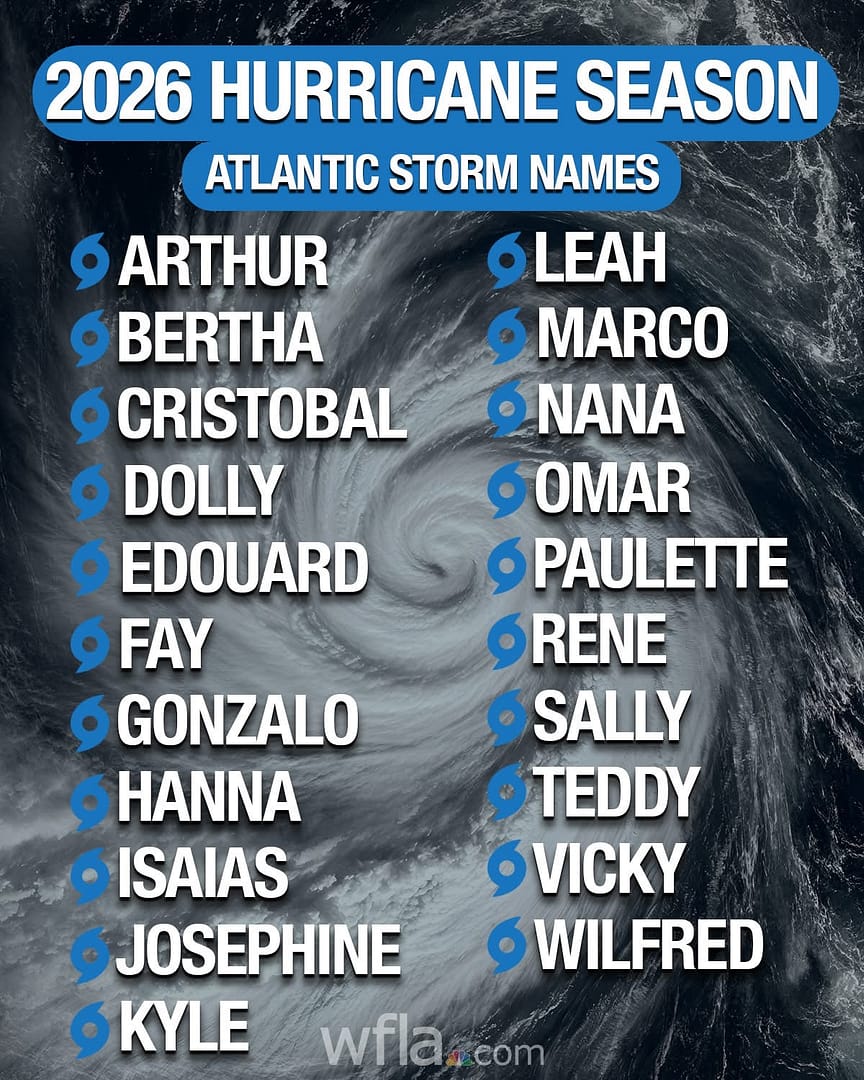



(WFLA) — The 2026 Atlantic hurricane season is less than 100 days away, and while no one can predict exactly when the first storm will appear, we’ve known its name for years: Arthur.

Ever wondered how hurricanes get their names, or what this year’s storms will be called? Read on to find out more.
The World Meteorological Organization maintains lists of 21 names that are used in a six-year rotation. If 2026’s names sound familiar, it’s likely you heard them in 2020.

When a tropical storm strengthens and reaches wind speeds of 39 mph or higher, it’s given a name from the list, beginning in alphabetical order.

List of names for the 2026 Atlantic Hurricane Season:
| Arthur | Hanna | Omar |
| Bertha | Isaias | Paulette |
| Cristobal | Josephine | Rene |
| Dolly | Kyle | Sally |
| Edouard | Leah | Teddy |
| Fay | Marco | Vicky |
| Gonzalo | Nana | Wilfred |
Why do hurricanes have names?
Prior to the 1950s, tropical cyclones were tracked by the order in which they formed each year, according to NOAA. This led to confusion when multiple storms were churning in the Atlantic simultaneously.
“Storms are given short, distinctive names to avoid confusion and streamline communications,” according to the NOAA website.

From 1953 to 1979, only female names were used for storms.
The WMO committee convenes annually and removes a name from the list if it is associated with an especially costly or deadly storm. This is done “for reasons of sensitivity,” according to the National Hurricane Center. The most recently retired names were Beryl, Helene and Milton after the 2024 hurricane season.

A total of 99 names have been removed from the Atlantic hurricane list since 1953. The full list can be found on the National Hurricane Center website.
What happens if all names are used before the season ends?
In 2021, the WMO created a supplemental list of names to be used in case the regular list was exhausted. This came after a busy 2020 season that blew through the regular list of names, plus the entire Greek alphabet, which was the previous backup plan.
The WMO chose to stop using the Greek alphabetbecause it drew attention away from the storms themselves and was difficult to translate. It resulted in concurrent storms with similar-sounding names, which caused confusion.
The committee also retired Eta and Iota that year.
Why aren’t there names for all 26 letters of the alphabet?
The WMO determined there simply aren’t enough names beginning with Q, U, X, Y, and Z. They would need six of each, plus a few in reserve, in case a name gets retired.
Names beginning with those letters can also be difficult to understand across multiple languages.
Advertise with the mоѕt vіѕіtеd nеwѕ ѕіtе іn Antigua!
We offer fully customizable and flexible digital marketing packages.
Contact us at [email protected]




Marco might be a bad one
You know when I was younger I never took hurricanes seriously until I experienced hurricane Luis in 1995. Hurricanes are becoming more ferocious and deadly because of climate change. I happened to be in Jamaica last year when hurricane Melissa struck and it wasn’t a beautiful sight. I am urging my country members and women to start preparing and take hurricanes seriously. Climate change is no joke and hurricanes are becoming more and more powerful. The devastating effects of climate change are right now being felt in parts of the US with unusual snow storms and very strong winds
Comments are closed.